
How to Roast a Turkey: Temperature, Time by Weight and When It Is Done
The pop-up timer and the clear-juices test both get it wrong. Here is the timetable to plan with, the three spots a thermometer has to go, and the fix when the breast is done before the legs.
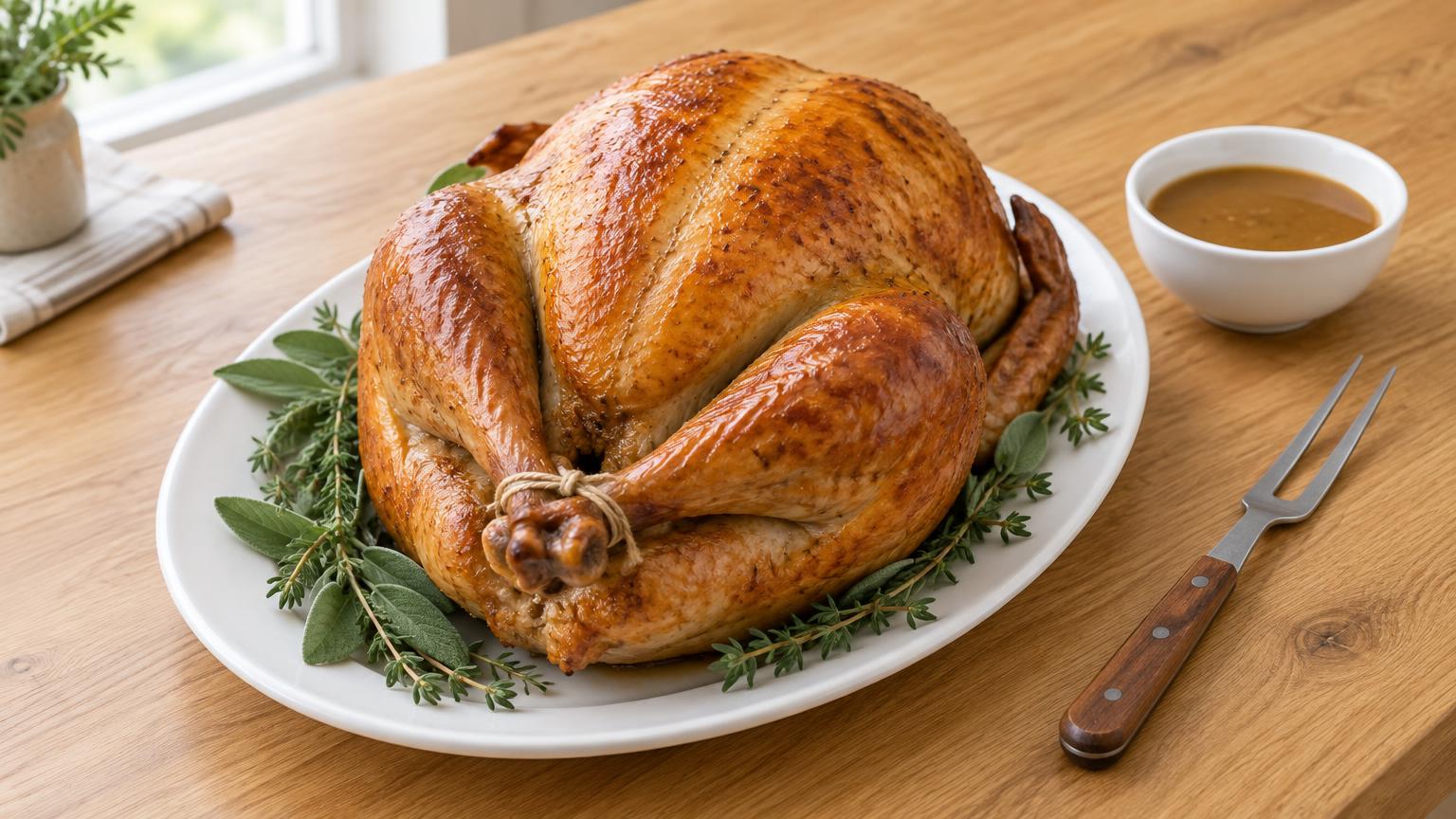
Roast a thawed turkey at 325°F (165°C). An unstuffed 12- to 14-pound bird takes about 3 to 3¾ hours; the table below covers other sizes. Then trust a thermometer, not the clock. The turkey is done when the thickest part of the breast, the innermost part of the thigh and the innermost part of the wing all read at least 165°F (74°C). Let it rest 20 minutes before carving.
That is the whole method. The rest of this guide is about getting each part right: the oven temperature, the timing by weight, where the thermometer goes, and what to do when the breast and legs disagree.
Oven temperature: why 325°F
The USDA advises roasting turkey in an oven set no lower than 325°F (165°C). Lower than that, the bird spends too long warming through the temperatures where bacteria multiply. Much higher for the whole roast and the outer breast overcooks long before the thighs are ready, because a big turkey is a lot of meat for heat to travel through.
Some cooks start hotter, at 425°F (220°C) for the first 30 minutes, to brown the skin, then drop to 325°F for the rest. That works well and shortens the total slightly. Either way, check early.
How long to roast a turkey by weight
These are the USDA's approximate times for a fully thawed, unstuffed turkey at 325°F (165°C):
| Turkey weight | Approximate roasting time |
|---|---|
| 8 to 12 lb (3.6 to 5.4 kg) | 2¾ to 3 hours |
| 12 to 14 lb (5.4 to 6.4 kg) | 3 to 3¾ hours |
| 14 to 18 lb (6.4 to 8.2 kg) | 3¾ to 4¼ hours |
| 18 to 20 lb (8.2 to 9.1 kg) | 4¼ to 4½ hours |
| 20 to 24 lb (9.1 to 10.9 kg) | 4½ to 5 hours |
A stuffed turkey takes longer, and the stuffing in the middle has to reach 165°F (74°C) as well. The USDA prefers you bake stuffing in a separate dish, which is why our classic sage stuffing is written that way.
A turkey that went into the oven still frozen takes at least 50 percent longer. If yours is not fully thawed, see how long to thaw a turkey and give yourself extra time.
Treat the table as a schedule for when to start checking, not a promise. Oven accuracy, the shape of the bird, whether it was brined and how often the door opens all move the finish by half an hour or more. Start checking the temperature 45 minutes before the earliest time in the range.
Step by step
- Get it ready. Take the neck and giblets out of both cavities. Pat the skin dry with paper towels; dry skin browns, wet skin steams. Do not rinse the bird: rinsing spreads raw poultry juices around the sink without making the turkey safer.
- Season. Rub the skin with 2 to 3 tablespoons (30 to 45 g) of soft butter or oil. If you did not brine, season all over with about 1 tablespoon (9 g) of Diamond Crystal kosher salt per 5 pounds (2.3 kg). Morton kosher salt and table salt are denser, so use about half the volume of those. Tuck the wing tips under the body so they do not burn.
- Set it up. Put the turkey breast side up on a rack in a shallow roasting pan, so hot air reaches the underside. Add a cup (240 ml) of water or stock to the pan so drippings do not scorch; you want them for gravy.
- Roast. Put the pan on the lowest oven shelf, which gives the tall bird room and keeps the breast farther from the top heat. Roast at 325°F (165°C).
- Shield the breast. When the breast skin is deep golden, usually about two-thirds of the way through, lay a loose tent of foil over the breast only. The legs keep browning while the breast slows down.
- Check the temperature in all three places shown below, starting 45 minutes before the earliest time in the table.
- Rest. Move the turkey to a board or platter, tent loosely with foil and leave it 20 minutes. The juices settle back into the meat instead of running onto the board when you cut, and the meat is easier to slice.
How to tell the turkey is done
Use a food thermometer. Pop-up timers and clear juices are not reliable signs, and colour tells you nothing: turkey can stay pink at a safe temperature, or look done before it is.
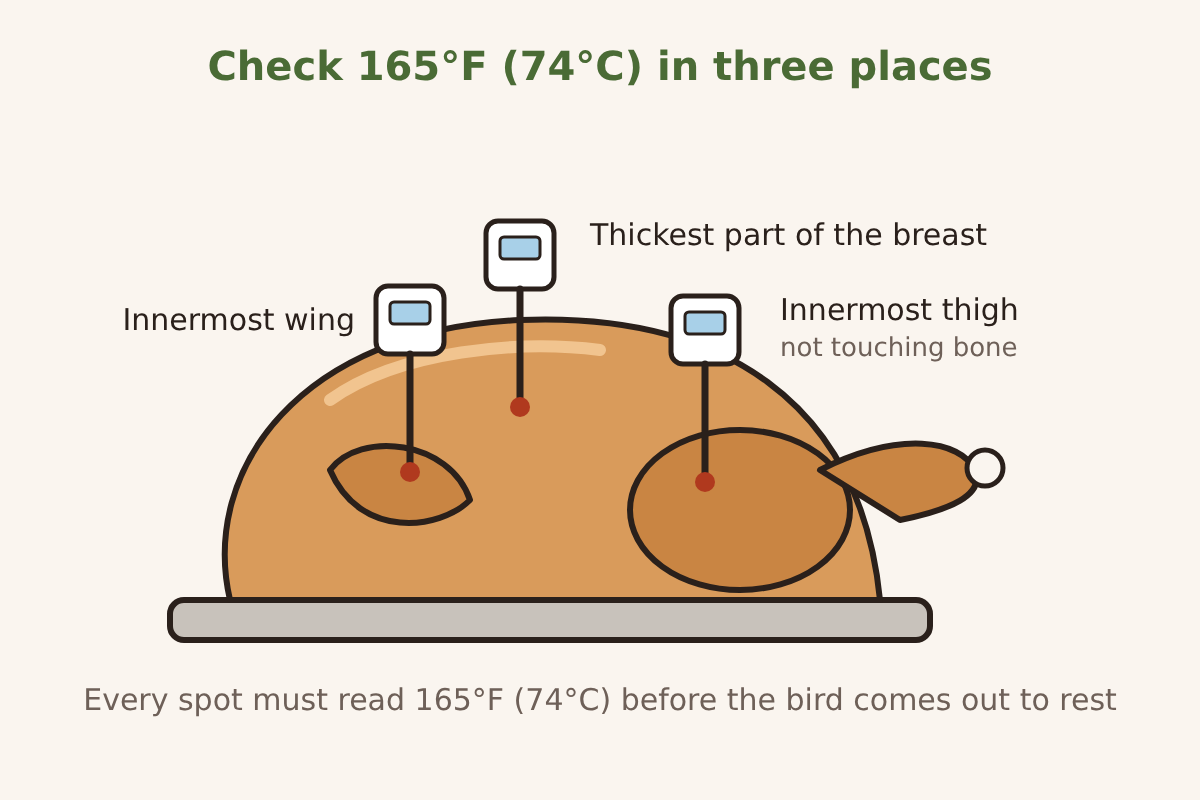
Push the probe into:
- The thickest part of the breast, coming in from the neck end, to the middle of the meat.
- The innermost part of the thigh, the thick part near the body, without touching the bone.
- The innermost part of the wing, where it joins the body.
The turkey is safe when every one of them reads at least 165°F (74°C). If you stuffed it, check the centre of the stuffing too.
Many cooks find thigh meat more pleasant at 175°F (79°C) or so, because the connective tissue softens further, while breast meat dries out the longer it climbs past 165°F. Tenting the breast earlier is the fix for that.
When the breast is done before the legs
This is the classic turkey problem. A few ways to handle it:
- Tent the breast with foil as soon as it is browned, as above.
- Turn the pan around halfway through. Most ovens run hotter at the back, and turning evens out the browning.
- Take the legs off. If the breast is at 165°F (74°C) and the thighs are not, carve off the leg quarters, put them back in the oven on a tray, and rest the breast. It looks less grand, but it is how restaurants handle the same problem. Our carving guide shows where the joint is.
After the roast
Pour the pan drippings into a jug and let the fat rise. The dark juice under the fat is the most flavourful thing in the kitchen: whisk it into make-ahead gravy from turkey wings while the bird rests.
Get leftovers into the fridge within 2 hours of the turkey coming out of the oven. Take the meat off the bones first so it cools quickly in shallow containers.
If you have never roasted anything bigger than a chicken, the steps are the same as for a simple roast chicken, on a bigger scale and a longer clock.
