
Prime Rib Temperature and Time by Weight: A Chart for Bone-In and Boneless
Minutes per pound get you close, and a thermometer finishes the job. USDA roasting times for a rib roast by weight, the temperature to pull it at, and how to get a dark crust without a burnt outside.
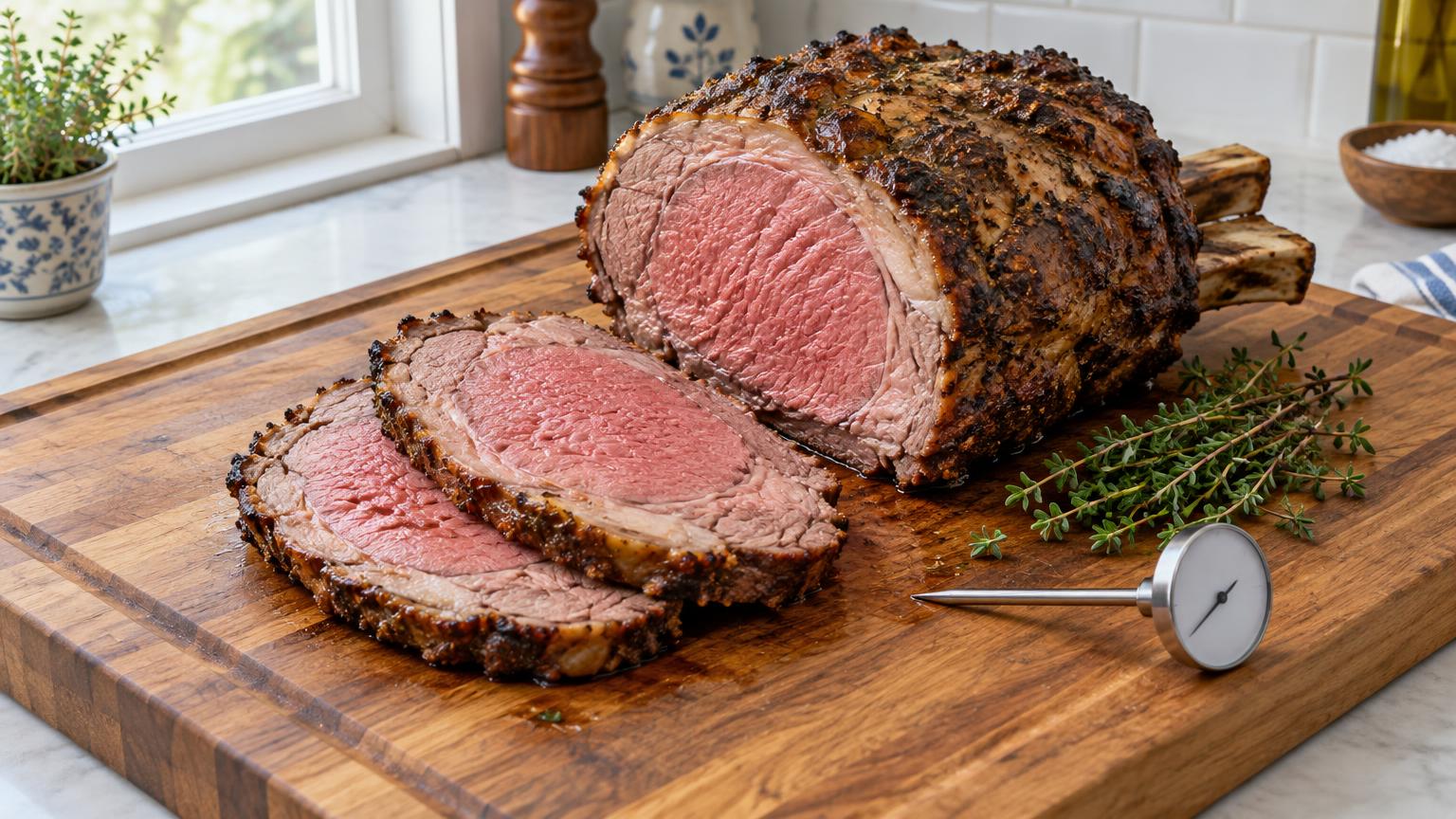
Roast prime rib at 325°F (165°C) for about 23 to 25 minutes per pound if it is bone-in and 4 to 6 pounds, so a 5-pound roast takes roughly 2 hours. Start checking 45 minutes before the earliest time, and take it out when the center reads 145°F (63°C). That is the USDA's safe minimum for beef roasts, followed by a rest of at least 3 minutes. A longer 30-minute rest gives you cleaner slices and time to brown the crust.
Serves: 6 to 8 from a 7 pound (3.2 kg) roast Prep time: 15 minutes, plus 1 to 2 days salting in the fridge Cook time: about 3 hours, plus 30 minutes resting Contains: dairy only if you use butter. Use oil to keep it dairy-free. No gluten, nuts, eggs, shellfish or soy.
Prime rib cooking time by weight
These are USDA roasting times at 325°F (165°C). The totals are worked out from the minutes per pound.
| Roast | Weight | Minutes per pound | Approximate total |
|---|---|---|---|
| Bone-in | 4 lb (1.8 kg) | 23 to 25 | 1½ to 1¾ hours |
| Bone-in | 5 lb (2.3 kg) | 23 to 25 | 2 to 2¼ hours |
| Bone-in | 6 lb (2.7 kg) | 23 to 25 | 2¼ to 2½ hours |
| Bone-in | 7 lb (3.2 kg) | 23 to 30 | 2¾ to 3½ hours |
| Bone-in | 8 lb (3.6 kg) | 23 to 30 | 3 to 4 hours |
| Boneless, rolled | 4 lb (1.8 kg) | 28 to 33 | 2 to 2¼ hours |
| Boneless, rolled | 6 lb (2.7 kg) | 28 to 33 | 2¾ to 3¼ hours |
Treat the table as a schedule for when to start checking. USDA publications do not all agree on boneless roasts, and one holiday chart runs longer for a 4-pound roast, so a thermometer has the last word. A roast over 8 pounds (3.6 kg) falls outside the chart. Allow plenty of spare time and go by temperature.
What temperature to pull prime rib
| Doneness (USDA) | Internal temperature |
|---|---|
| Medium rare, and the safe minimum | 145°F (63°C) |
| Medium | 160°F (71°C) |
| Well done | 170°F (77°C) |
Measure in the thickest part of the center, without touching bone. Bone reads hotter than the meat around it. Check in two spots, because a long roast rarely heats evenly.
The temperature keeps climbing by several degrees after the roast leaves the oven, so a roast pulled at 145°F (63°C) will carve a little past that in the middle and more done toward the ends. That spread is useful at a big table, since some guests want the pinker center and others want the end cut. Many restaurant and magazine recipes pull prime rib much earlier for a redder middle. Those temperatures sit below the USDA's guidance, so we do not recommend them, least of all when you are feeding young children, older relatives or anyone who is pregnant.
Why 325°F and not lower
The USDA advises against roasting meat in an oven below 325°F (165°C), because the meat can spend too long warming through the range where bacteria multiply. A 325°F oven is still gentle enough for a rib roast. Because the outer layers cook more slowly than they would in a hot oven, you get less of a gray band under the crust. Our guide to searing meat for a brown crust explains what high heat adds, and we use a short blast of it at the end.
Ingredients
- 1 bone-in beef rib roast, 7 pounds (3.2 kg), about 3 to 4 ribs
- 1½ tablespoons (14 g) Diamond Crystal kosher salt, or half that volume of Morton kosher or table salt
- 1 tablespoon (7 g) coarsely ground black pepper
- 2 tablespoons (30 ml) neutral oil or soft butter
- 1 tablespoon (3 g) chopped fresh thyme, optional
Steps
- Salt it early. One or two days ahead, rub the roast all over with the salt and set it on a rack over a tray on the lowest fridge shelf, uncovered. The salt seasons deeper than the surface and the outside dries, and a dry surface browns. The same logic is behind a dry brine for turkey.
- Heat the oven to 325°F (165°C) with a rack in the lower third.
- Rub the roast with the oil or butter, then the pepper and thyme. Stand it fat side up in a shallow roasting pan, resting on its bones. The ribs work as a built-in rack.
- Roast. Start checking 45 minutes before the earliest time in the chart, then every 15 minutes as it nears the target.
- Take the roast out at 145°F (63°C) in the center. Put it on a board and tent loosely with foil.
- Rest for 30 minutes. The juices thicken as the meat cools slightly, so less of them runs out when you cut.
- While it rests, turn the oven up to 500°F (260°C). If the crust needs more color, slide the roast back in on the pan for 6 to 10 minutes, watching it closely.
- Carve. Cut along the bones to lift the whole roast off in one piece, stand it flat and slice across the grain, ½ to ¾ inch (1 to 2 cm) thick. Save the rib bones for anyone who wants them, or for stock.
How much to buy
Plan on about 1 pound (450 g) of bone-in roast per person, or one rib for every two people, a common butcher's rule that leaves some for sandwiches. For boneless, about ½ pound (225 g) per person is enough.
Using the pan
Pour off most of the clear fat. Set the pan over medium heat, add 1 cup (240 ml) of beef stock and scrape up the brown bits for a thin sauce. If you would rather have gravy, a simple roux thickens it smoothly. Check the label on boxed stock if you are cooking for someone avoiding gluten or soy.
Storage and reheating
Get leftovers into the fridge within 2 hours of the roast leaving the oven. Keep sliced beef in shallow containers for 3 to 4 days, or freeze it for 2 to 3 months for best quality. Reheat to 165°F (74°C), covered, with a splash of stock so the slices do not dry out.
