
How Long to Thaw a Turkey: Fridge and Cold-Water Times by Weight
A 20-pound turkey needs five days in the fridge, so the start date sneaks up fast. Here is the date to begin for your bird's size, and the cold-water rescue if you are already late.
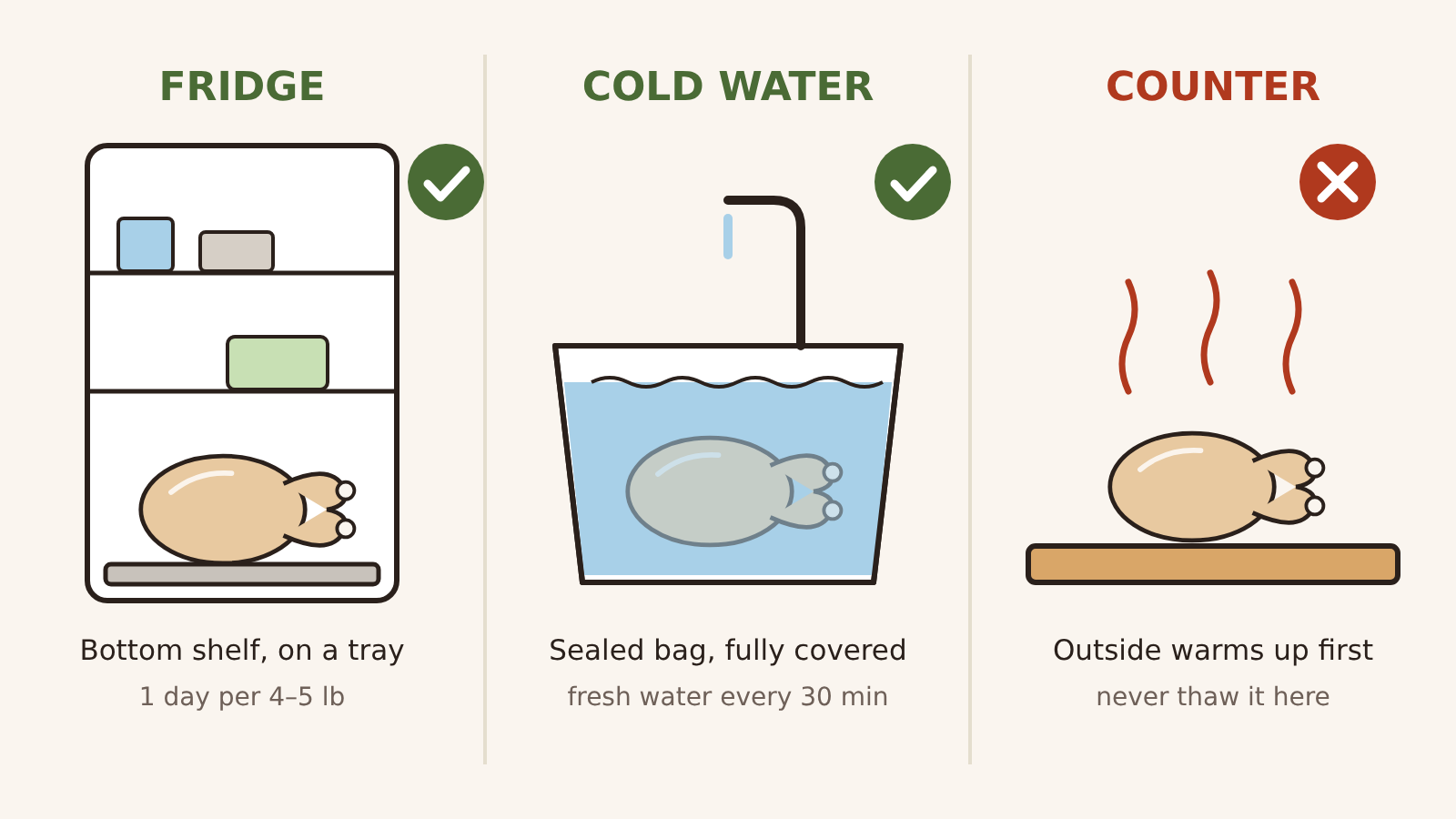
A frozen turkey thaws safely in one of three ways: in the refrigerator (about one day for every 4 to 5 pounds), in cold water (about 30 minutes per pound, changing the water every 30 minutes), or in the microwave if it fits. Never on the counter. For Thanksgiving on Thursday, November 26, 2026, that means a 20-pound bird goes into the fridge on the Friday or Saturday before.
The times below come from the USDA Food Safety and Inspection Service (FSIS). They are the numbers to plan around, and they are longer than most people expect.
Refrigerator thawing times by weight
The fridge is the method the USDA recommends, because the turkey stays at 40°F (4°C) or below the whole time. Allow roughly 24 hours for every 4 to 5 pounds (about 2 kg):
| Turkey weight | Time in the refrigerator |
|---|---|
| 4 to 12 lb (1.8 to 5.4 kg) | 1 to 3 days |
| 12 to 16 lb (5.4 to 7.3 kg) | 3 to 4 days |
| 16 to 20 lb (7.3 to 9.1 kg) | 4 to 5 days |
| 20 to 24 lb (9.1 to 10.9 kg) | 5 to 6 days |
Working back from Thanksgiving Day, put the bird in the fridge by these dates if you want it ready to cook Thursday morning:
- 20 to 24 lb: Friday, November 20
- 16 to 20 lb: Saturday, November 21
- 12 to 16 lb: Sunday, November 22
- 4 to 12 lb: Monday, November 23
Leave it in its original wrapper and set it on a rimmed tray or in a roasting pan on the bottom shelf. Turkeys leak as they thaw, and the bottom shelf keeps raw juices from dripping onto anything ready to eat.
Check your fridge is actually at 40°F (4°C) or colder with an appliance thermometer. A fridge running a few degrees warm thaws faster but sits closer to the range where bacteria grow quickly; one running very cold can leave you with an icy bird on Thursday, so give yourself the early end of the range.
Once thawed, a turkey can stay in the fridge for 1 to 2 more days before you cook it. That buffer is why starting a day early costs you nothing.
Cold-water thawing times by weight
Forgot to move the turkey? Cold water is much faster, because water carries heat into the frozen bird far better than air does. Plan on about 30 minutes per pound:
| Turkey weight | Time in cold water |
|---|---|
| 4 to 12 lb (1.8 to 5.4 kg) | 2 to 6 hours |
| 12 to 16 lb (5.4 to 7.3 kg) | 6 to 8 hours |
| 16 to 20 lb (7.3 to 9.1 kg) | 8 to 10 hours |
| 20 to 24 lb (9.1 to 10.9 kg) | 10 to 12 hours |
How to do it:
- Keep the turkey in its wrapper, and make sure the wrapper has no holes. If it does, slip the bird into a large leak-proof bag. Water that gets in makes the meat waterlogged and can carry bacteria from the surface around the bird.
- Put it breast side down in a clean sink, cooler or large pot, and cover it completely with cold tap water.
- Change the water every 30 minutes. Fresh cold water keeps the outside of the turkey cold while the middle catches up.
- Cook the turkey as soon as it has thawed. A bird thawed in cold water should not go back into the fridge to wait.
A 20-pound turkey needs about 10 hours of this, with 20 water changes, so it is a whole-day job: start in the early morning of the day you will roast, about 10 hours before the bird needs to go into the oven.
Microwave thawing
If the turkey fits in your microwave, check the owner's manual for the defrost setting and time per pound. Take off all the wrapping first. Microwave thawing warms parts of the bird enough to start cooking them, so the turkey has to go straight into the oven afterwards. For most birds over about 12 pounds this method is off the table on size alone.
Why not the counter or the garage
On the counter, the outer layers of a big turkey warm up past 40°F (4°C) hours before the centre has thawed. Bacteria on the surface multiply in that warm layer, even while the inside is still frozen. The garage, the porch and a car trunk have the same problem with less predictable temperatures. Hot water does it faster still. None of these is safe, however cold the day feels.
Cooking a turkey that is still frozen
If Thursday arrives and the bird is still solid, you can roast it from frozen. The USDA says it is safe, but it takes at least 50 percent longer than a thawed turkey. Pull out the neck and giblet bag with tongs once the bird has softened enough, usually after the first couple of hours, and check the temperature in several places at the end, as you would for any turkey. Our guide on roasting a turkey and checking when it is done has the timings and where to put the thermometer.
A partly thawed bird is the same story on a smaller scale: it will cook unevenly and take longer, so test early and test in more than one spot.
How to tell the turkey has thawed
Reach into the main cavity. If you can pull out the neck and the bag of giblets easily and there are no ice crystals inside, it is ready. The thighs should move freely at the joint. If the cavity is still icy, run cold water through it for a few minutes. Keep the neck: it adds flavour to a pot of make-ahead turkey gravy.
Refreezing and planning ahead
A turkey thawed in the fridge can go back into the freezer without being cooked, though it may lose a little moisture. A turkey thawed in cold water or the microwave cannot: cook it first, then freeze the cooked meat.
Thawing is the first item on the calendar, but not the only one. If you plan to dry brine the turkey, it needs to be thawed a day or two before Thursday, so count those days in when you work back from the table.
