
Choosing a Roasting Pan for Turkey: Size, Depth and the Rack
A shallow pan about 2 to 3 inches deep, a little bigger than the bird, with a rack under it. How to size it to your turkey and oven, which material suits you, and what to use if you have no roasting pan.
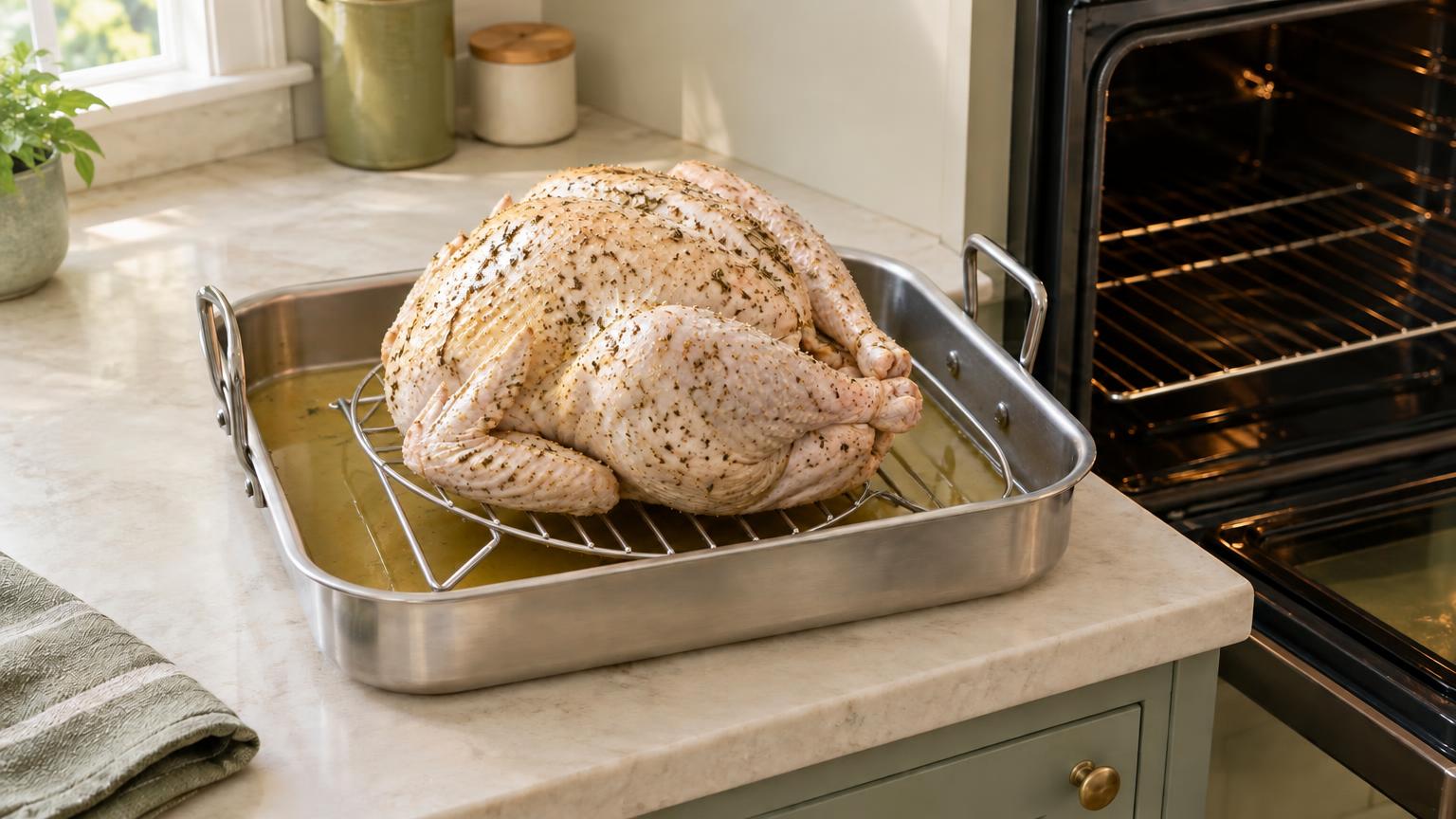
For a turkey you want a shallow roasting pan, about 2 to 3 inches (5 to 7.5 cm) deep, a little bigger than the bird on every side, with a rack that lifts the turkey off the bottom. That combination lets oven heat reach the thighs and the underside while the drippings collect below for gravy. If you don't own one, a rimmed sheet pan with a wire rack, or a disposable foil pan set on a sheet pan, will do the job.
The rest of this guide covers how to pick the size, why depth matters more than most people expect, which materials suit which cook, and what to do if the pan you have is wrong.
Why the pan changes the turkey
A turkey roasts by hot air moving around it. Anything that blocks that air slows the part of the bird behind it.
Tall sides block air at exactly the wrong place. The thighs sit low on the bird and need the most heat, because dark meat near the bone is the last part to reach a safe temperature. In a deep pan they sit in a pocket of still air while the breast, up in the open, keeps cooking. You end up with a breast that is past done before the legs are ready, the most common turkey complaint there is.
A rack fixes the other half of the problem. Without one, the bottom of the bird sits in its own juices. Wet skin steams instead of browning, so the underside comes out pale and soft. Lifting the bird even an inch lets air pass underneath and keeps the skin out of the liquid.
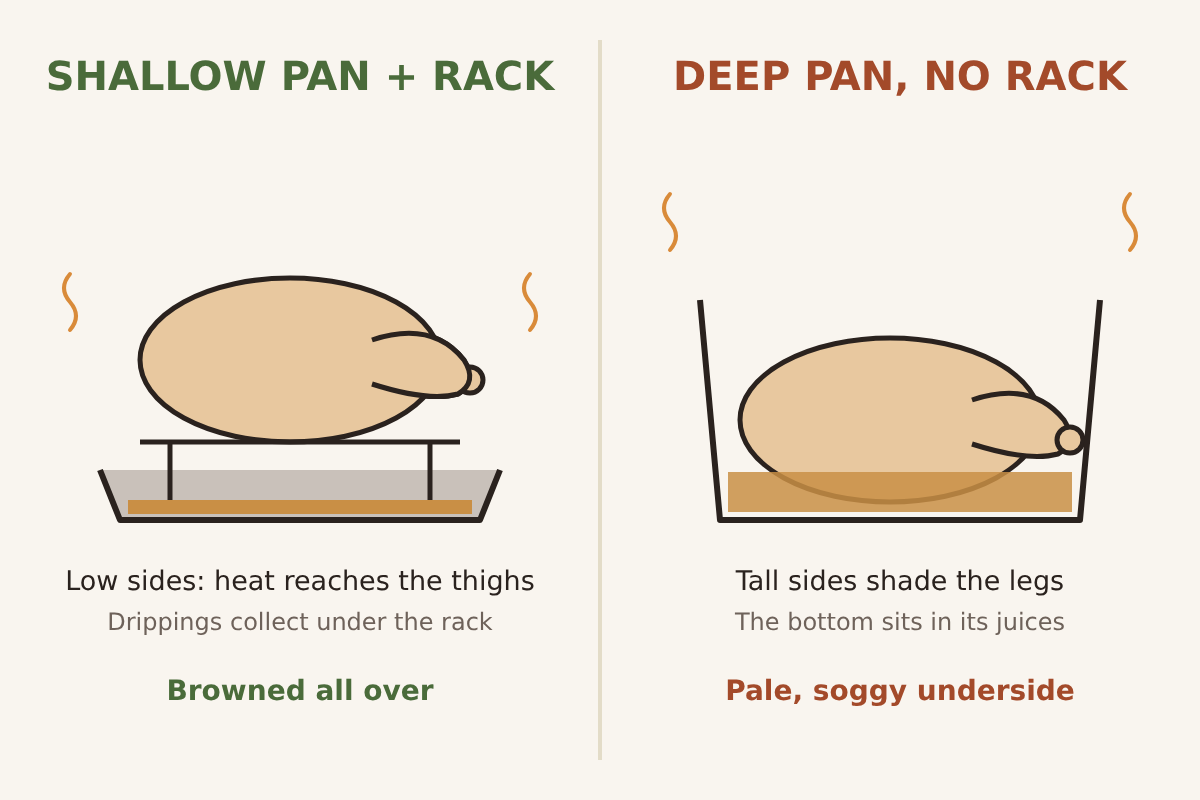
This is why the USDA's turkey instructions call for the bird to go breast side up on a rack in a shallow roasting pan, and why our guide to roasting a turkey by weight sets it up the same way.
What size roasting pan you need
Two measurements matter: the turkey and your oven.
Room around the bird. Aim for roughly 2 inches (5 cm) of clear pan floor between the turkey and each side. Too tight and the wings and legs hang over the edge, so drippings run onto the oven floor and smoke. Too big and the juices spread into a thin film that dries out and burns before you can make gravy from it.
Room around the pan. Hot air needs to circulate around the pan as well, so it should not touch the oven walls or door. Measure the inside of your oven before the holiday, not the morning of. Many standard ovens take a large roaster with a little room on each side, but smaller and older ovens may not.
The easiest check: a few days ahead, set the wrapped, still-frozen or thawing turkey in the pan, and slide the empty pan onto the lowest oven shelf. If the bird fits with a margin and the oven door closes with the pan inside, you are set.
Do you need a rack?
You need the bird lifted, but it doesn't have to be a store-bought rack.
- A V-rack cradles the turkey upright and makes it easy to lift out: grab the rack's handles with oven mitts and the bird comes with it.
- A flat wire rack works just as well for browning. The bird sits a little less steadily, so tuck the wings under and check it is level.
- No rack at all. Thick slices of onion, a few carrots and celery ribs laid across the pan make a raft that holds the turkey up, and they flavour the drippings. Tight coils of foil work too. Either way, the aim is about an inch (2.5 cm) of space under the bird.
Add about a cup (240 ml) of water or stock to the pan before it goes in, so the first drippings land in liquid instead of scorching on a dry, hot pan. Then check it halfway through and add a splash more if the bottom looks dry.
Which material to choose
Stainless steel, often with an aluminium core, is the workhorse. It is heavy, doesn't warp, and in most cases can go straight onto a burner after the roast so you can scrape up the browned bits for gravy, the same way you would for a pan sauce in a skillet. Check the maker's instructions for your pan before putting it on a burner.
Enamelled steel roasters, the speckled kind often sold with a domed lid, are light and inexpensive. Many are deeper than ideal. If yours is, leave the lid off and lift the bird on a rack or a vegetable raft so the legs sit above the rim.
Dark or nonstick pans brown faster than shiny ones, because a dark surface absorbs more heat. Keep an eye on the drippings so they don't scorch, and use wooden or silicone tools so you don't scratch the coating.
Glass and ceramic dishes are fine for a chicken or a turkey breast if they are wide and fairly shallow. Don't put them on a burner, and don't pour cold liquid into a hot dish: sudden temperature changes can crack it.
A large cast-iron skillet roasts a small bird or a turkey breast well, and our comparison of skillets explains how it holds heat.
No roasting pan? What to use instead
A rimmed sheet pan with a wire rack. A half sheet pan is 18 by 13 inches (46 by 33 cm) with a rim of about an inch (2.5 cm), which keeps the legs fully exposed. It suits a smaller turkey that fits on it with room to spare, and it is ideal for a spatchcocked bird, which lies flat and cooks faster. The catch is the low rim: a big bird can release more juice than it holds. Add only a little liquid, check halfway, and spoon some drippings into a jug if the pan is filling. Slide it in and out slowly with the pan level.
A disposable foil pan. These are thin and fold when you lift a heavy bird by the edges. Always set the foil pan on a sturdy sheet pan for the whole roast and carry it by the sheet pan, never by the foil. Many foil pans are deep, so use a rack or a raft to lift the bird.
A large, shallow baking dish can hold a turkey breast or a small bird. The same rack-or-raft rule applies.
Moving a hot pan safely
A roasted 14-pound (6.4 kg) turkey plus a pan of hot fat is a heavy load. Clear a landing spot on the counter before you open the oven. Use dry oven mitts, not a damp towel, which passes heat straight through. Pans with upright handles are far easier to grip with mitts than ones with flat side tabs. If the bird is large, have a second person ready.
Lift the turkey out of the pan to rest on a board, then deal with the drippings. Whatever pan you use, the turkey is done only when a thermometer reads at least 165°F (74°C) in the thickest part of the breast, the innermost thigh and the innermost wing.
Gravy first, then cleaning
Pour the drippings into a jug, let the fat rise and keep the dark juice underneath for make-ahead turkey gravy. If your pan can go on the stove, add a little stock to it over medium heat and scrape up the browned bits; they dissolve and add a lot of flavour.
Once the pan is empty and cool enough to handle, fill it with hot, soapy water and leave it to soak while you eat. Most stuck-on bits lift off after that with a nylon scrubber. On stainless steel, a paste of baking soda and a little water rubbed over stubborn brown spots usually clears them. Get the cooled leftovers into the fridge within 2 hours of the turkey coming out of the oven.
