
How to Make a Pan Sauce in the Skillet You Seared Meat In
Deglaze the brown bits, reduce by half and swirl in cold butter: how to make a glossy pan sauce in about 10 minutes, why each step works, and how to fix a greasy, thin or salty sauce.
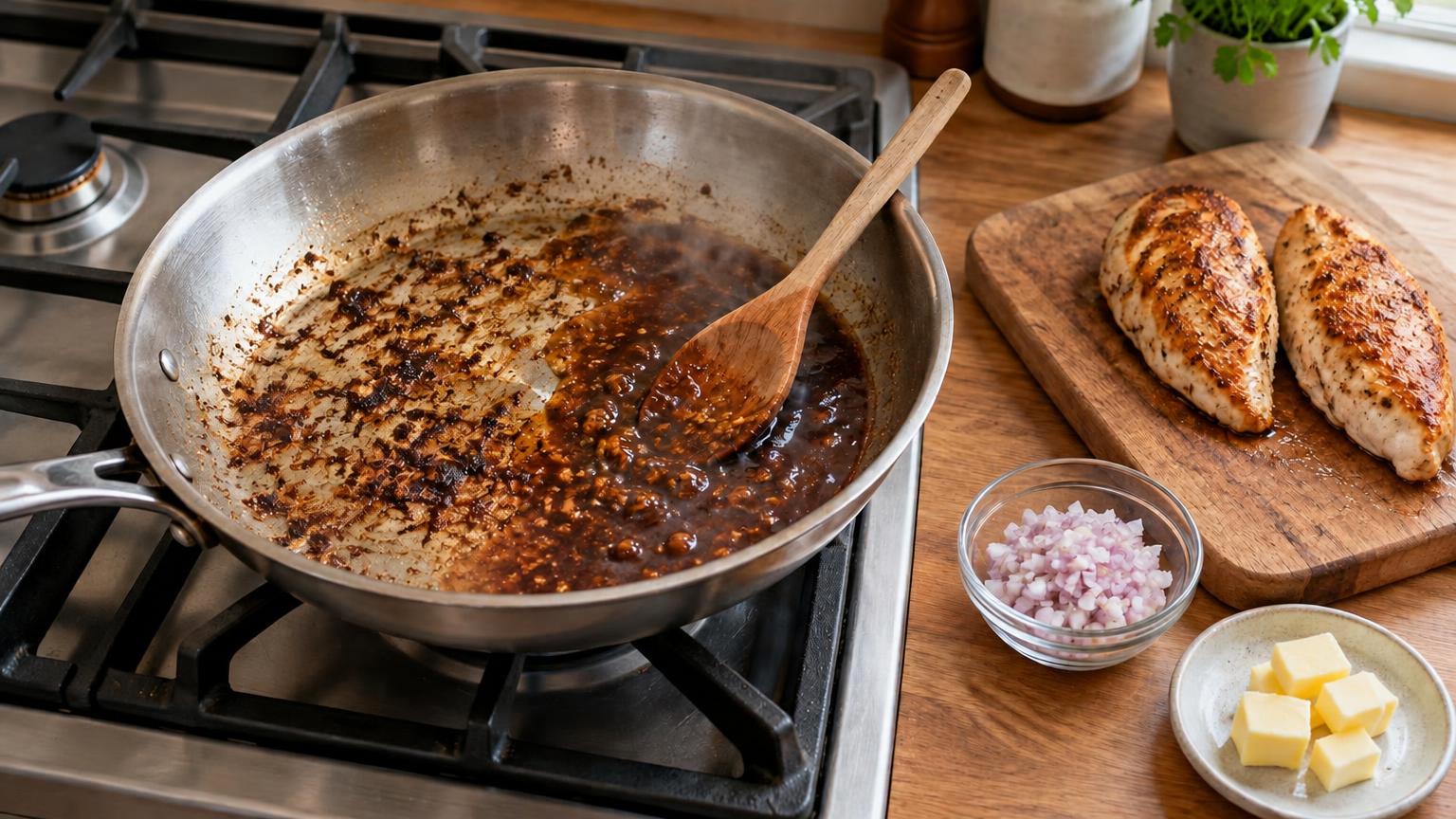
A pan sauce is the quick sauce you make in the skillet you just seared meat in. Lift the meat out, pour off most of the fat, soften a little shallot, then pour in wine or stock and scrape up the brown bits stuck to the pan. Simmer it until it has reduced by about half, take the pan off the heat and swirl in a few cubes of cold butter. It takes about 10 minutes while the meat rests, and it turns a plain chicken breast, pork chop or steak into a finished dish.
Active time: about 10 minutes. Makes: enough sauce for 2 to 4 servings of meat.
Why the brown bits matter
When meat sears, juices and proteins from its surface stick to the hot pan and brown there. Cooks call this layer fond, from the French for "base". It is concentrated flavour from the same Maillard browning that gives seared meat its crust, and it dissolves readily in liquid. Pouring in wine or stock while the pan is hot is called deglazing: the liquid loosens the fond, and everything that browned on the pan ends up in your sauce instead of the sink.
Fond needs a pan that meat can stick to a little. Stainless steel, cast iron and carbon steel all build a good layer; nonstick pans are made to stop food sticking, so they leave very little behind. Our guide to which skillet suits which job goes into the differences.
Ingredients
Listed in the order you use them:
- 1 tablespoon (15 ml) fat left in the pan after searing
- 1 medium shallot, finely chopped (about 3 tablespoons or 30 g)
- ½ cup (120 ml) dry white wine, or more stock
- ¾ cup (180 ml) chicken stock, low-sodium if you can find it
- 1 teaspoon (5 ml) lemon juice or Dijon mustard
- 2 tablespoons (30 g) cold unsalted butter, cut into 4 cubes
- Salt and black pepper, to taste
- 1 tablespoon chopped parsley or chives (about 4 g), optional
Allergens: butter contains dairy, and some stocks contain gluten or soy, so check the label. For a dairy-free sauce, skip the butter and whisk in 1 tablespoon (15 ml) olive oil at the end; the sauce will be thinner and less glossy. Alcohol does not all cook off in a short simmer, so use stock with a teaspoon (5 ml) of white wine vinegar in place of the wine if you prefer to avoid it.
How to make a pan sauce, step by step
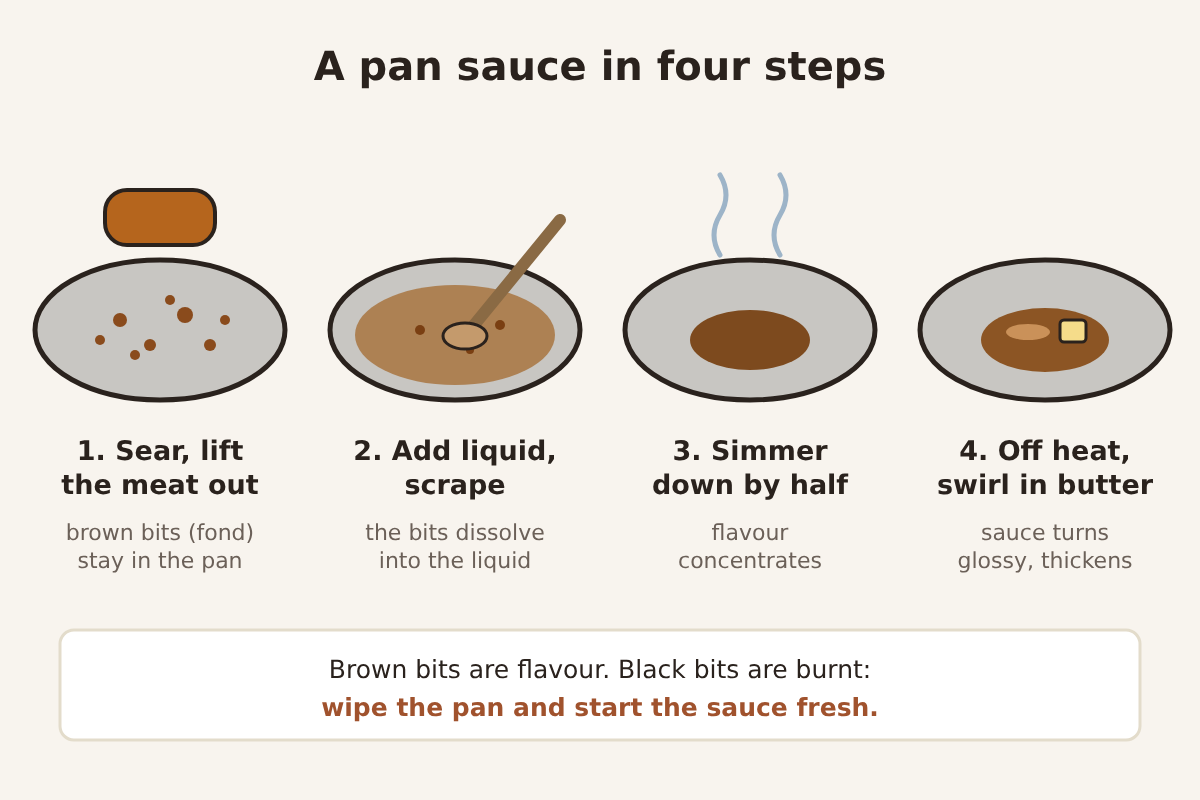
- Sear the meat and cook it to a safe temperature. Check with an instant-read thermometer: USDA guidance is 165°F (74°C) for chicken, and 145°F (63°C) with a 3-minute rest for pork chops and beef steaks. Move the meat to a plate and cover it loosely with foil.
- Check the fond. Brown is good. If parts are black and smell acrid, the sauce will taste bitter; wipe the pan out and make the sauce with fresh fat.
- Pour off the extra fat, leaving about 1 tablespoon (15 ml). Lower the heat to medium.
- Soften the shallot. Stir it in the fat for about 1 minute, until it turns translucent. The moisture it releases starts loosening the fond.
- Deglaze. Pour in the wine and scrape the bottom of the pan with a wooden spoon or flat spatula until the brown bits dissolve. Let it bubble until it has nearly disappeared, 1 to 2 minutes.
- Add the stock and reduce. Simmer briskly until the liquid has reduced by about half and coats the back of a spoon, about 4 to 6 minutes. Reducing is what concentrates the flavour and gives the sauce body. Pour in any juices that have collected under the resting meat.
- Take the pan off the heat. Stir in the lemon juice or mustard, then add the butter one cube at a time, swirling the pan or stirring until each cube melts before adding the next. Cold butter, added off the heat, stays suspended in tiny droplets and makes the sauce thick and glossy: an emulsion of fat held in the liquid. If you want a larger batch that holds well on the stove, thicken with flour instead, as in a roux for smooth sauces and gravy.
- Taste and season. Add salt and pepper, and the herbs if you are using them. Spoon it over the meat and serve straight away.
How to tell each stage is done
- Deglazed: the bottom of the pan looks clean, and the liquid has turned from clear to brown.
- Reduced: bubbles get bigger and slower, and the sauce leaves a thin coat on a spoon. Drag a finger across the coated spoon; the line should hold for a moment.
- Finished: the sauce looks glossy rather than oily and moves like light cream.
Common mistakes and how to fix them
Greasy or separated sauce: the butter got too hot and the emulsion broke. Take the pan off the heat, add 1 tablespoon (15 ml) cold water or stock, and whisk hard; it usually comes back together.
Too thin: it needs more reducing. Put it back on the heat before the butter goes in, or, if you have already added the butter, simmer it very gently for a minute. In a hurry, stir 1 teaspoon (3 g) cornstarch into 1 tablespoon (15 ml) cold water and whisk it into the simmering sauce.
Too salty: stock reduces along with everything else, so its salt concentrates. Start with low-sodium stock and salt only at the end. If it is already too salty, add a splash of water or unsalted stock and a squeeze of lemon.
Bitter: the fond burned, or the garlic or shallot did. There is no fixing it; start again in a clean pan with a little butter or oil and fresh stock.
Variations
Swap the liquids and finishes to suit the meat. Red wine and a sprig of thyme with steak. Cider or apple juice with pork, finished with a spoonful of whole-grain mustard. For a creamy sauce, reduce the stock, then simmer in ¼ cup (60 ml) heavy cream for a minute instead of adding butter (this keeps the dairy). The method stays the same: brown, deglaze, reduce, finish.
