
How to Braise Meat So It Turns Tender, Not Tough
Brown the meat, add liquid halfway up, cover and cook it low in the oven until a fork slides in. Here is why a gentle simmer beats a boil, and how to tell a braise is done.
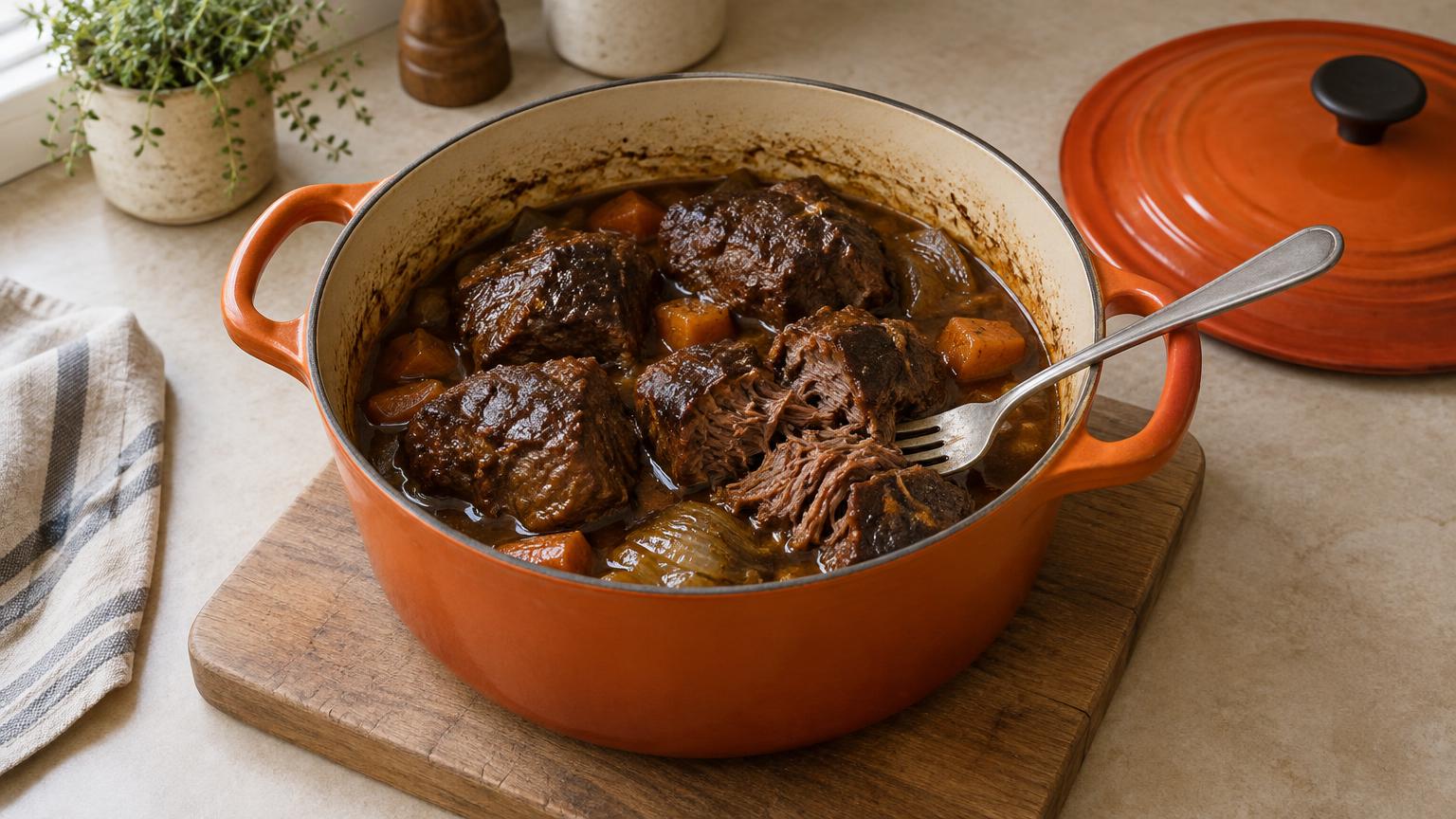
To braise meat so it turns tender instead of tough, brown it well, add liquid that comes about halfway up the pieces, cover the pot and cook it low and slow, in a 300 to 325°F (150 to 165°C) oven, until a fork slides in with no resistance. For beef chuck, short ribs or pork shoulder that usually takes 2½ to 3½ hours. The single most common mistake is letting the liquid boil: it makes even a good cut dry and stringy.
Braising suits the cuts that are hardest to cook any other way: beef chuck, short ribs, brisket, pork shoulder, lamb shanks and bone-in chicken thighs. Those muscles worked hard, so they are full of connective tissue. That is what makes them chewy on the grill and what makes them silky in a braise.
What happens inside the pot
Tough cuts are held together by collagen, the connective tissue that wraps the muscle fibres. Cooked fast, it shrinks and squeezes the meat. Cooked slowly in moist heat, it melts into gelatin, and gelatin is what gives braised meat its soft, pull-apart texture and gives the liquid its body.
That melting is slow. It gets going once the meat's centre passes about 160°F (70°C) and speeds up as the temperature climbs. Beef chuck usually reaches fork-tender somewhere around 195 to 205°F (90 to 96°C) inside, which is far past USDA's safe minimum of 145°F (63°C) for whole cuts of beef and pork and 165°F (74°C) for poultry. With braising, safety is never the question. Time is.
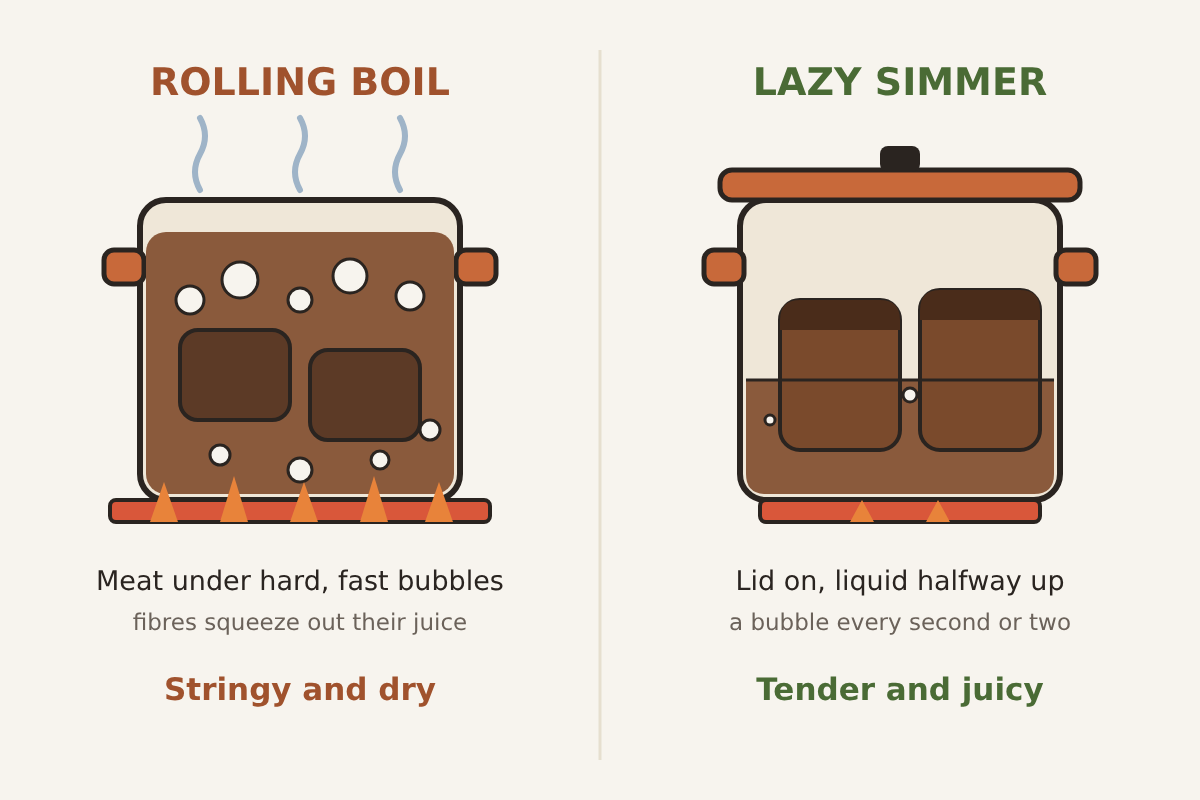
Here is the catch. The muscle fibres themselves tighten and push out moisture as they heat. A hard boil, around 212°F (100°C) and churning, does that quickly and dries the meat out before the collagen has finished melting. A gentle heat gives the collagen time to turn to gelatin while the fibres lose as little juice as possible. That is why the oven is the best place for a braise: it surrounds the pot with steady, moderate heat, so the liquid sits just below a simmer for hours without you watching it.
How to braise, step by step
This works for about 3 to 4 pounds (1.4 to 1.8 kg) of meat in a heavy 5 to 7 quart (4.7 to 6.6 litre) pot with a tight lid. An enamelled cast-iron Dutch oven is ideal because it holds heat evenly, but any heavy, oven-safe pot works.
- Heat the oven to 300 to 325°F (150 to 165°C), with a rack low enough that the covered pot fits.
- Dry and season the meat. Cut beef or pork into large pieces, about 2 to 3 inches (5 to 7.5 cm), or leave short ribs and shanks whole. Pat them dry with paper towels and salt them generously, about 1 teaspoon of fine salt (6 g) per pound (450 g). Dry meat browns; wet meat steams.
- Brown it in batches. Heat 2 tablespoons (30 ml) of oil in the pot over medium-high heat until it shimmers (here is how to tell your pan is hot enough). Add only as many pieces as fit with space between them and leave them alone until they release easily and are deep brown, 3 to 5 minutes a side. Move them to a plate. Browning adds flavour the liquid alone never will; the method is the same as searing a steak for a deep crust.
- Cook the aromatics. Pour off all but about 1 tablespoon of fat. Add 1 diced onion, 2 carrots and 2 celery stalks cut in chunks, with a pinch of salt, and cook over medium heat until softened, about 5 minutes. Stir in 3 sliced garlic cloves and 2 tablespoons (32 g) tomato paste and cook until the paste darkens, about 2 minutes.
- Deglaze. Pour in 1 cup (240 ml) of wine, stock or water and scrape up every brown bit from the bottom. Those bits are concentrated flavour.
- Add liquid to halfway. Return the meat and its juices. Add stock until the liquid comes about halfway up the meat, usually 2 to 3 cups (480 to 720 ml) more. Tuck in 2 sprigs of thyme and a bay leaf. The tops of the pieces should sit above the liquid, where they brown slightly in the oven's dry heat instead of boiling.
- Bring to a bare simmer, cover and move to the oven. Heat on the stove just until the first bubbles appear, put the lid on and slide it into the oven.
- Check after 1½ hours. Lift the lid. You should see a bubble breaking the surface every second or two. If it is boiling hard, drop the oven by 25°F (about 15°C). If nothing moves at all, raise it by the same. Turn the pieces so the tops get a turn in the liquid.
- Cook until a fork slides in easily, usually 2½ to 3½ hours in total for beef chuck, short ribs, pork shoulder or lamb shanks, and 1 to 1½ hours for bone-in chicken thighs.
How to tell a braise is done
Forget the clock and test the meat. Push a fork into the thickest piece and twist. If it slides in with no resistance and the piece starts to come apart, it is done. If the fork meets springy resistance, the collagen has not finished melting: put the lid back and check again in 20 to 30 minutes.
Meat that is tough after 2 hours is almost never overcooked. It needs more time. Overcooked braised meat looks different: it falls into dry threads and the pieces have shrunk hard.
Finish the sauce
Lift out the meat and the herbs. Tilt the pot and spoon off the fat that pools on top. Then pick one:
- Reduce it. Simmer the liquid uncovered on the stove until it coats a spoon, 10 to 15 minutes. Taste and add salt only at the end, because reducing concentrates it.
- Thicken it. Whisk in a little roux, cooked flour and butter, and simmer until glossy.
Return the meat to warm through in the sauce.
Better the next day
Braises reheat better than almost anything else, so they suit cooking for guests. Cool the pot uncovered for no more than 2 hours, then refrigerate it, covered. Overnight, the fat sets in a hard layer on top that lifts straight off, and the meat absorbs more of the liquid. USDA guidance is to eat cooked leftovers within 3 to 4 days, and to reheat them until they reach 165°F (74°C). Reheat gently, covered, in a 325°F (165°C) oven or over low heat on the stove, with a splash of stock if it looks dry.
Common braising mistakes and fixes
- Meat is dry and stringy. The liquid boiled. Next time lower the heat and check the pot after 1½ hours.
- Meat is tough. It needs more time. Keep cooking and test every 30 minutes.
- Sauce tastes flat. The meat was not browned well, or the pot was crowded and steamed. Brown in batches and wait for a deep colour.
- Sauce is greasy. Skim the fat before reducing, or chill the braise overnight and lift the fat off.
- Sauce is too salty. You salted the liquid before reducing it. Add unsalted stock and simmer again.
Allergens and swaps
The method itself is free of the common allergens. Watch the extras: some recipes dust the meat in flour before browning (gluten; skip it, or thicken the sauce at the end with a cornstarch slurry instead), some stocks contain soy or gluten (check the label), and a butter-and-flour roux adds dairy and gluten.
