
How to Choose, Store and Cut Winter Squash
The fridge is the wrong place for a whole butternut, and a round squash on a cutting board is how kitchen knives slip. What to look for in the shop, how long each kind keeps, and the safe way in.
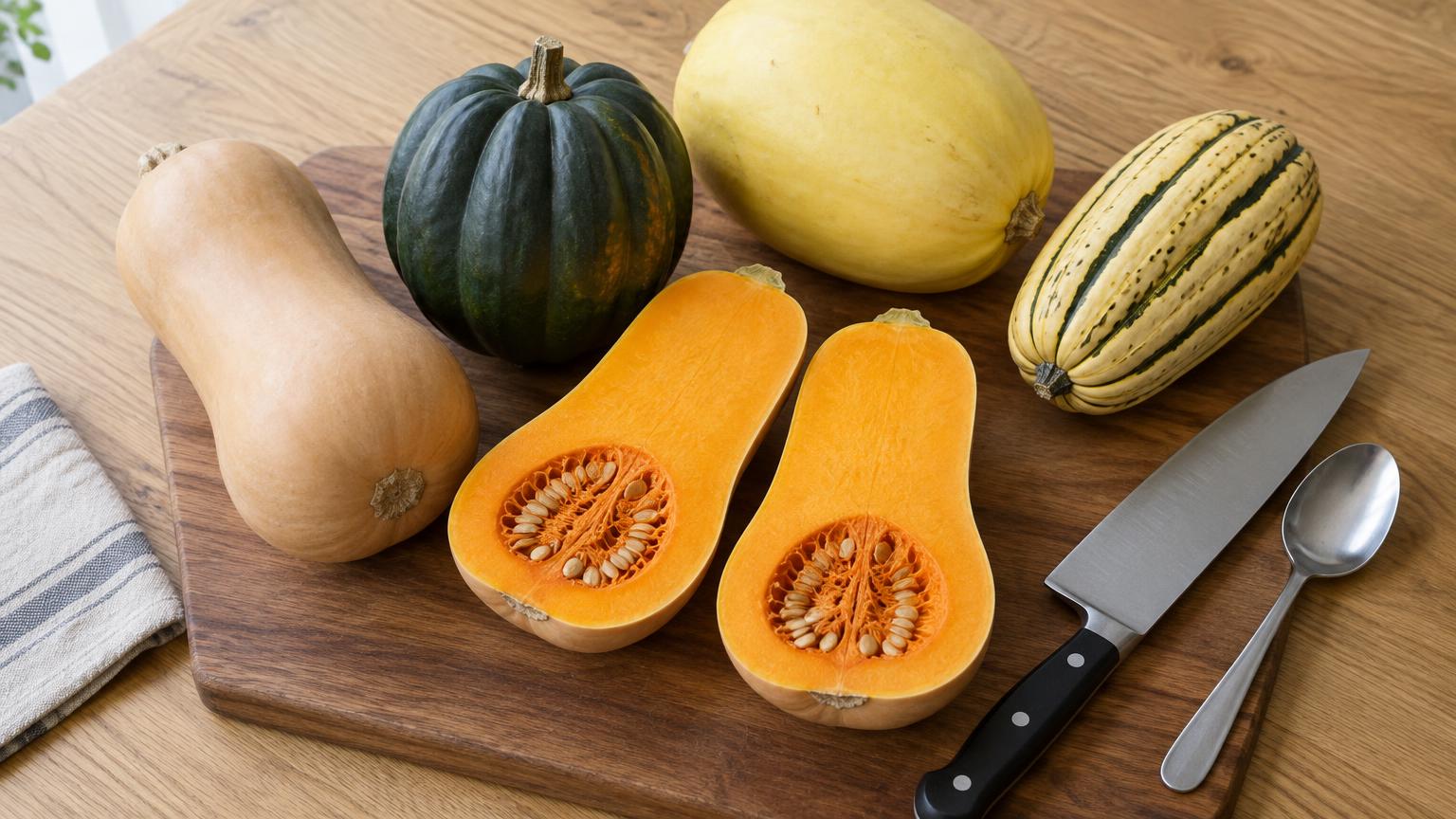
Pick a winter squash that feels heavy for its size, with hard, unbroken skin, no soft or wet spots and a dry, firm stem. Store it whole somewhere cool and dry, ideally 50 to 60°F (10 to 15°C), not in the fridge, and most kinds keep for one to several months. To cut one safely, slice a thin piece off one side so it sits flat, then cut it on that stable base with a big, sharp knife.
That is the short version. Here is how to apply it to the squashes you will actually find in the shop this fall.
The common winter squashes, and what each is good for
- Butternut: tan skin, long neck, small seed bulb. Smooth, sweet, dense flesh with very little stringiness. The best all-rounder for roasting in cubes, soup and purees, and the easiest to peel.
- Acorn: ribbed, dark green, sometimes with an orange patch. Milder and a little fibrous. Best halved or cut into wedges and roasted with the skin on, which holds the pieces together.
- Delicata: cream-coloured with green stripes, long and narrow. The skin is thin enough to eat once roasted, so there is no peeling at all. Slice into half-moons and roast.
- Spaghetti: pale yellow, oval. The cooked flesh pulls apart into long strands with a fork. Mild, so it takes on whatever sauce you give it.
- Kabocha: squat, dark green, dull skin. Very dense, dry and sweet, almost chestnut-like. Excellent roasted and in curries.
- Hubbard: very large, warty, blue-grey, green or orange. Often sold in cut pieces. Dense and sweet, good for pies and mashing.
- Sugar or pie pumpkin: small, about 2 to 4 lb (1 to 2 kg). Smooth, sweet, fairly dry flesh. This, not a carving pumpkin, is the one to cook with; a carving pumpkin is bred to be big and thin-walled, and its flesh is watery and stringy.
How to choose a good one
- Heavy for its size. Pick up two of the same size; the heavier one has denser flesh and has lost less moisture.
- Hard skin. Press with a thumbnail. A ripe winter squash resists; soft or easily dented skin means it was picked immature or is starting to break down.
- Intact stem. A dry, firm stem, still attached, helps a squash keep. Squash with a missing stem can spoil from that spot first, so use those soon.
- Matte skin on most types. A dull finish on acorn and butternut is a sign of maturity; glossy skin often means it was picked early.
- No bruises or wet spots. Small surface scratches are fine. Soft, sunken or mouldy patches are not.
How to store winter squash
Whole winter squash keeps best in a cool, dry, airy place, around 50 to 60°F (10 to 15°C): an unheated spare room, a cool cupboard, a basement. Set them on a shelf or in a basket in a single layer, not touching, and check them every week or two, using any that develop soft spots straight away.
Keep them out of the fridge while whole. Fridge temperatures are below 50°F (10°C), which can cause chilling injury, so the squash breaks down faster. Keep them away from ripening apples, pears and bananas too: those fruits give off ethylene gas, which shortens squash storage life.
How long each type keeps varies with the variety and how it was grown and cured, so treat these as a guide drawn from university extension storage tables:
| Type | Typical storage life, whole |
|---|---|
| Acorn | about 1 to 2 months |
| Spaghetti | about 1 to 3 months |
| Butternut | about 2 to 3 months, longer in ideal conditions |
| Hubbard | about 5 to 6 months |
Delicata has thinner skin than these and is best used within the first few weeks. Kitchen counters and warm rooms shorten all of these times.
Once cut, wrap the pieces tightly or put them in a sealed container in the fridge. Colorado State University Extension advises using cut squash within 1 to 2 days. Cooked squash is a cooked leftover: refrigerate it within 2 hours and use it within 3 to 4 days, or freeze it. For freezing, the National Center for Home Food Preservation's method is to cook the squash until soft, mash or puree it, cool it quickly and pack it in containers with a little headspace.
How to cut a winter squash safely
Most kitchen knife accidents with squash happen because a round, hard vegetable rolls under the blade. Give it a flat base first.
- Use the right knife. A heavy chef's knife, 8 to 10 inches (20 to 25 cm), and sharp. A small or dull knife wedges and slips.
- Steady the board. Put a damp towel under the cutting board so it cannot slide.
- Make a flat side. Lay the squash on its side and slice a thin strip off the length of it. Turn it onto that cut side. Now it cannot roll.
- Trim the ends. Cut off the stem end and the blossom end.
- Cut in half. For acorn, kabocha and pumpkins, cut through from the stem end to the base. For butternut, first separate the neck from the bulb, then halve the bulb.
- Never force a stuck knife by putting your hand on top of the blade. If it gets wedged, leave it in place, hold the handle and rock the squash and knife together against the board, or tap the back of the blade near the handle with a rolling pin.
- Scoop the seeds with a sturdy metal spoon. Keep the seeds if you like: they roast the same way pumpkin seeds do.
If it is too hard to cut, pierce the skin a few times with a fork and microwave the whole squash for 2 to 4 minutes. That softens the outer flesh enough to make cutting much easier, without cooking it through. Let it cool a minute before handling.
Peeling
Peel butternut with a sturdy Y-shaped vegetable peeler; it works better than a knife on the smooth skin. For ribbed acorn squash, do not bother peeling raw: roast it in wedges with the skin on and eat the flesh away from the skin, or scoop the cooked flesh out.
The simplest way to cook any of them
Heat the oven to 425°F (220°C). Toss cubes, wedges or halves with oil and salt, spread them out on a sheet pan with space between the pieces, and roast until tender and browned at the edges: about 25 to 35 minutes for 1 inch (2.5 cm) cubes, and 40 to 50 minutes for halves, cut side down. Crowded pieces steam instead of browning, the same reason we space meat out when we sear it.
The more you cut, the more a well-chosen knife and good technique pay off; the principle of a flat, stable side is the same one we use to dice an onion quickly and evenly. Roasted squash also makes a good side next to a simple roast chicken, roasted in the same oven.
