
How to Dice an Onion Quickly and Evenly
Dice an onion in about a minute: halve it through the root, slice toward the root without cutting through, then cut across. Sizes, safe knife grip, fewer tears and storage.
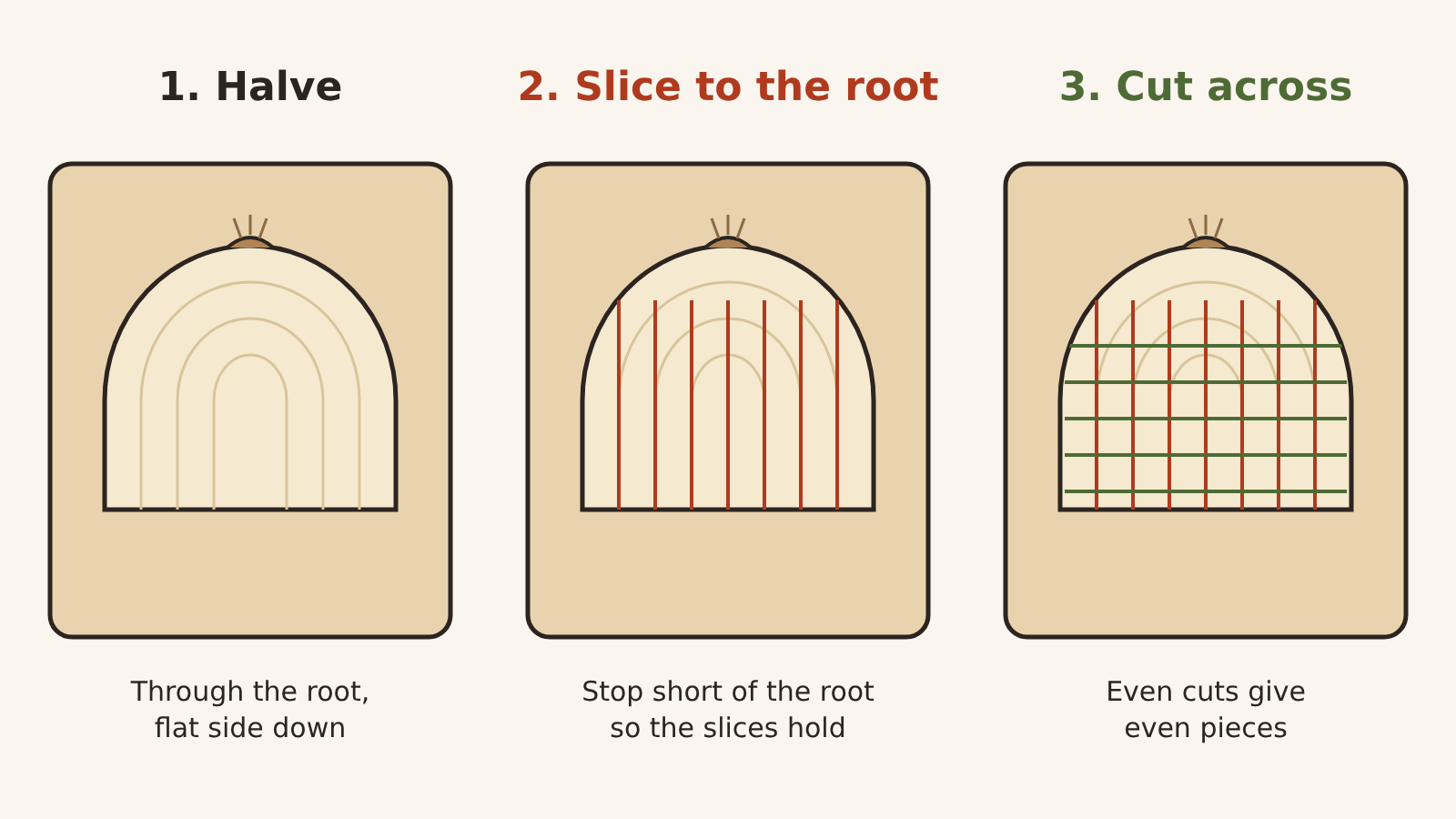
To dice an onion fast and evenly, cut it in half through the root, peel it, lay each half flat, slice toward the root without cutting through it, then cut across those slices. The root end holds the layers together while you work, so the onion stays in one piece until the last cut turns it into a neat pile. Once you have the pattern, a whole onion takes about a minute.
Onions start a huge number of recipes, from weeknight chili to chicken noodle soup, so this is the knife skill that pays back most often.
Why even pieces matter
Small pieces cook faster than large ones. In a pan of unevenly chopped onion, the little bits brown and then scorch while the big chunks are still crunchy and raw-tasting. Pieces of the same size soften and brown together, so the whole batch is done at the same moment and tastes the same in every spoonful. In a quick sauté this matters more than in a long-simmered stew, where everything softens eventually.
What you need
- A sharp chef's knife, 8 inches (20 cm) is the usual size. A sharp blade slices through the onion cleanly; a dull one slips off the curved skin, which is how most cuts to fingers happen, and it crushes the onion as it goes.
- A stable cutting board. Put a damp paper towel or cloth under it so it does not slide.
Step by step
- Trim the top. Lay the onion on its side and cut off the stem end (the pointed top), about ½ inch (1 cm) in. Leave the hairy root end alone. It is what keeps the onion together.
- Halve through the root. Stand the onion on the flat end you just cut and slice straight down through the middle of the root.
- Peel. Pull off the papery skin and, if it is tough or blemished, the first fleshy layer under it. Starting from the cut top makes this easy.
- Lay it flat. Put one half cut side down, with the root end pointing away from your knife hand. A flat side down means the onion cannot roll.
- Slice toward the root. Make vertical cuts from the top end toward the root, parallel to each other, stopping about ½ inch (1 cm) short of the root. Keep the tip of the knife on the board and lower the heel. The spacing of these cuts sets the size of the dice.
- Cut across. Now slice across the onion at right angles to your first cuts, at the same spacing, starting at the far end and working toward the root. Each slice falls away as small, even pieces.
- Finish the root end. When you reach the root, lay what is left on its side and chop it roughly, or save it for stock.

Do you need horizontal cuts?
Many recipes tell you to make one or two horizontal cuts toward the root before cutting across. Because an onion is built in layers, those layers already do most of that job for you, so on a small or medium onion you can skip them. On a very large onion, one horizontal cut halfway up gives smaller, more even pieces from the thick middle. Keep your flat hand on top of the onion and cut slowly, since the blade travels toward your palm.
Sizes, and how to get them
The spacing of your cuts in steps 5 and 6 sets the size. Recipes use these names:
- Fine dice or mince: about ⅛ inch (3 mm). Space the cuts as close as you can. Good for raw salsas, dressings and sauces where you want onion flavour without crunch.
- Small dice: about ¼ inch (6 mm). The most common size for soups and sautés, and the one to use for a recipe that just says "diced."
- Medium dice: about ½ inch (12 mm). For stews, chili and roasting, where the onion cooks for a long time and should keep some shape.
Keep your fingers safe
Hold the onion with your fingertips curled under, so your knuckles face the blade and your fingertips are tucked behind them. The flat side of the knife can then rest against your knuckles as a guide, and the edge never comes near your fingertips. Move your hand back a little after each slice.
Let the knife do the work in long strokes rather than pressing straight down. If the knife sticks or slips, stop and check that the onion is still lying flat.
How to cry less
Cutting an onion breaks open its cells, and that sets off a chemical reaction that releases an irritating gas. When it reaches your eyes, they water. You cannot stop the reaction, but you can slow it:
- Use a sharp knife. It slices through cells cleanly instead of crushing them, so less gas is released.
- Chill the onion for 30 minutes before cutting. Cold slows the reaction.
- Work quickly and move the diced onion to a bowl or into the pan as soon as you finish.
- Cut near a running stove hood or an open window, so the gas drifts away from your face.
Storing cut onion
Diced onion keeps in a sealed container in the fridge for a few days. The container matters more than you might expect: open, the smell spreads to everything else in the fridge, including butter and milk. Its flavour fades and it softens as it sits, so it is best cooked rather than eaten raw after the first day.
Diced onion also freezes well for cooking. Spread it on a tray, freeze until firm, then move it to a freezer bag. It goes straight into a hot pan without thawing. Once frozen and thawed it is too soft to use raw.
Other onions
The same pattern works for red onions, sweet onions and shallots, since they are all built from layers around a root. Shallots are small enough that you can skip any horizontal cut.
