
How Long Do Eggs Last in the Fridge? Storage Times, Dates and the Float Test
Raw eggs keep 3 to 5 weeks in the fridge, past the sell-by date. Here is how long yolks, whites, hard-boiled eggs and egg dishes keep, where to store eggs, how to read the carton and what the float test really shows.
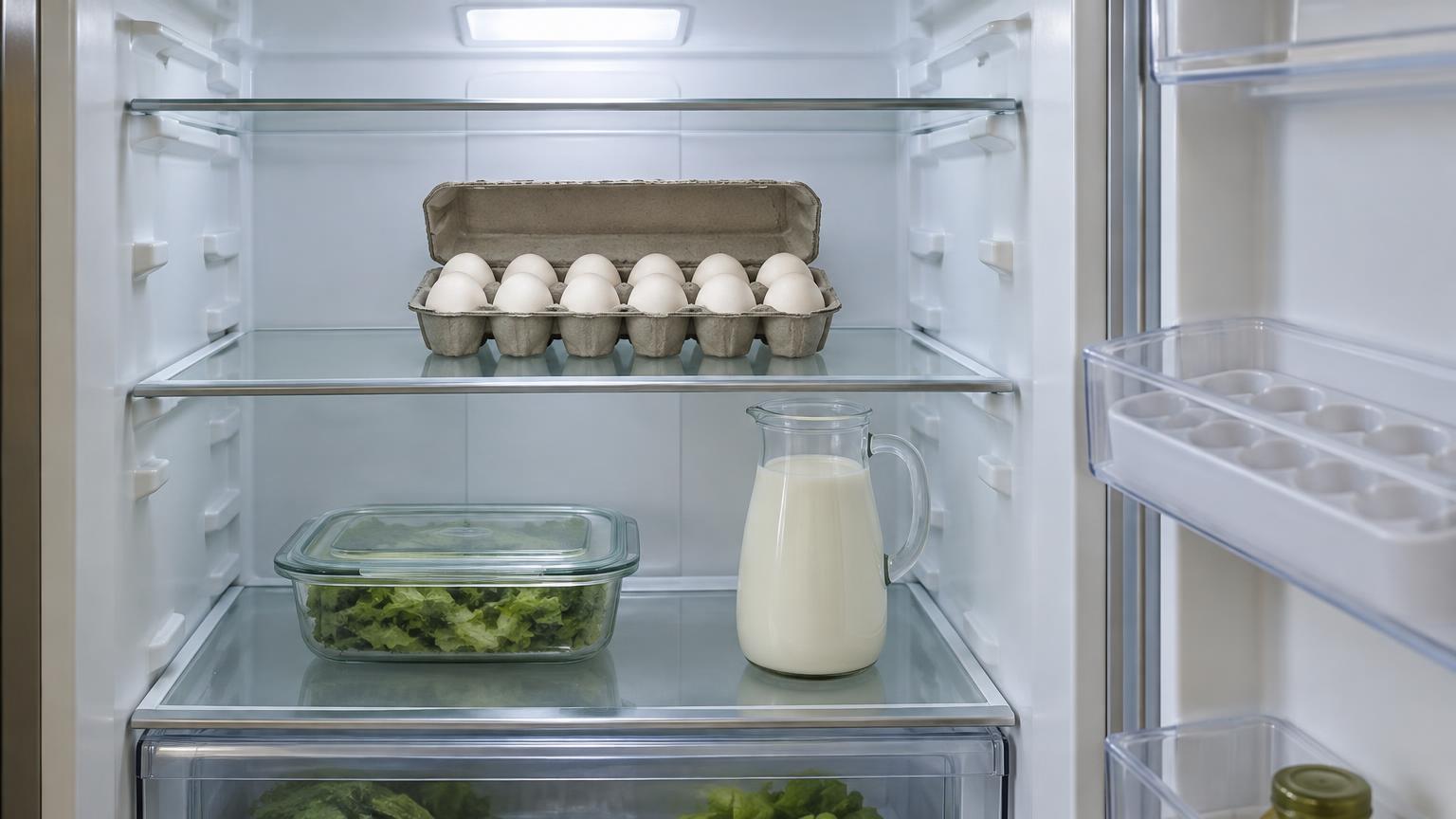
Raw eggs in the shell keep for 3 to 5 weeks in the refrigerator, counted from the day you bring them home, as long as the fridge holds 40°F (4°C) or colder. That is the USDA's guidance, and it holds even if the sell-by date on the carton passes partway through. Everything else about eggs (yolks, whites, hard-boiled, baked into a pie) has its own clock, and those are the numbers people usually get wrong.
How long eggs keep: the short version
These times follow the USDA Food Safety and Inspection Service storage chart for eggs, assuming a fridge at 40°F (4°C) or below and a freezer at 0°F (−18°C).
| Egg | Refrigerator | Freezer |
|---|---|---|
| Raw, in the shell | 3 to 5 weeks | Do not freeze in the shell |
| Raw whites | 2 to 4 days | 12 months |
| Raw yolks | 2 to 4 days | Do not freeze well plain (see below) |
| Hard-cooked, in or out of the shell | 1 week | Do not freeze |
| Casseroles made with eggs, baked | 3 to 4 days | 2 to 3 months |
| Pumpkin or pecan pie, baked | 3 to 4 days | 1 to 2 months |
The freezer times are for best quality. Food kept frozen at 0°F (−18°C) stays safe longer, but whites turn watery and baked dishes dry out past those marks.
Where eggs belong in the fridge
Keep eggs in the carton they came in, on a shelf inside the main body of the fridge. The little egg tray in the door is the worst spot you have: the door swings open dozens of times a day, so it runs warmer and its temperature jumps around. The carton matters too. It slows the loss of moisture through the shell and stops eggs from picking up smells from onions, cut cheese or leftovers.
Leave them pointed end down, the way they are packed. The air pocket sits at the wide end, and keeping it on top helps the yolk stay centred.
US eggs have to be refrigerated because they are washed before they are sold, which removes the thin natural coating on the shell. A cold egg left on a warm counter also sweats, and that moisture can help bacteria move through the shell's pores. The rule is the same as for other perishable food: no more than 2 hours at room temperature, or 1 hour when it is above 90°F (32°C).
Reading the dates on the carton
Cartons from USDA-graded plants carry a three-digit pack date: the day of the year the eggs were washed and packed, from 001 for January 1 to 365 for December 31. A carton stamped 305 was packed on November 1 (in a non-leap year).
Many cartons also show a sell-by or expiration date. Those dates are about quality and stock rotation, not a safety cutoff. Eggs bought before the sell-by date and kept cold are fine to use for the 3 to 5 weeks above, even if that runs past the printed date.
If an egg cracks on the way home, break it into a clean container, cover it and use it within 2 days. Don't buy cartons with cracked eggs in the first place: the shell is the egg's main protection.
What the float test tells you, and what it doesn't
As an egg ages, moisture and gas escape through the shell and the air pocket at the wide end grows. Lower an egg into a glass of cold water and that pocket shows you roughly how old it is.
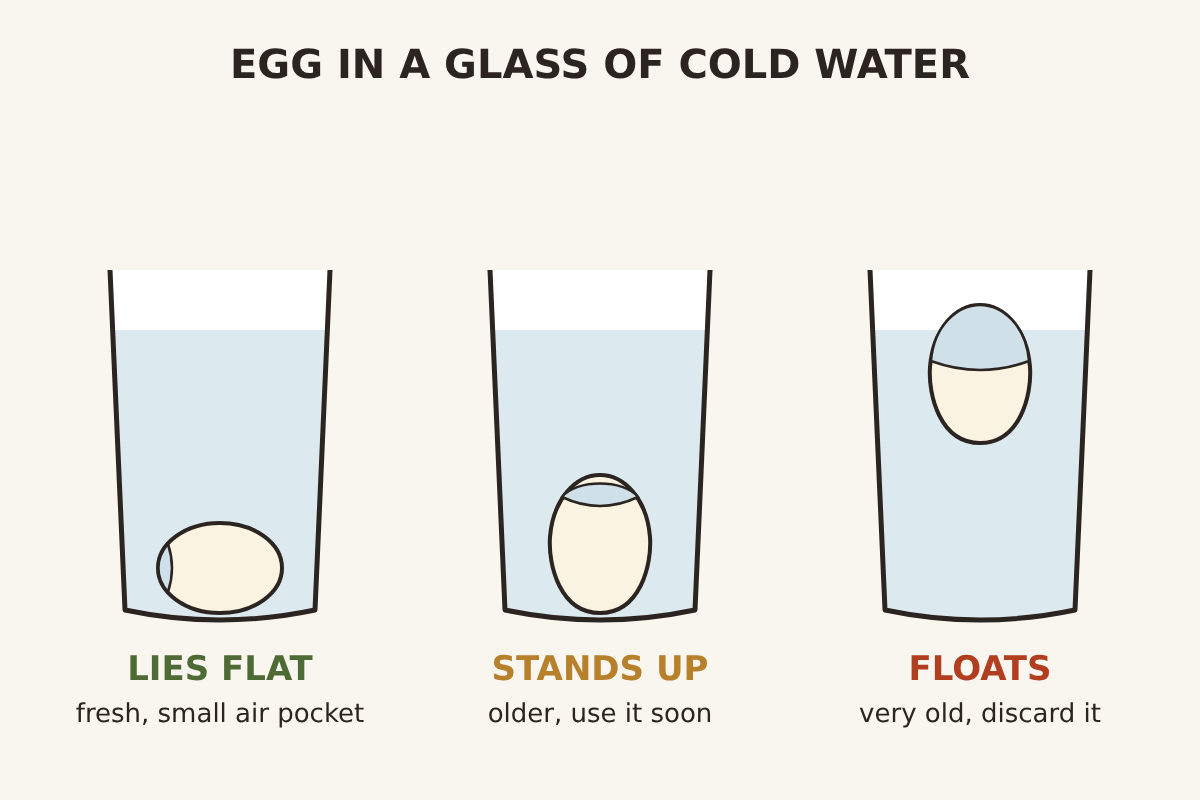
A fresh egg lies on its side at the bottom. An egg that tips up and stands on its pointed end is a few weeks old and fine to use soon; these are the ones to save for hard-boiling, because older eggs peel more easily. An egg that floats has lost a lot of moisture, and most cooks throw it out.
The catch: the test measures age, not safety. An egg can sink and still have been mishandled, and bacteria such as Salmonella do not change how an egg floats. Your best guide is still how long the eggs have been in your fridge. If you are unsure about one, crack it into a separate small bowl before adding it to anything else. An egg with an off smell or an odd colour goes in the trash, and the bowl saves the rest of your batter.
Freezing eggs you won't use in time
Whole eggs can't be frozen in the shell: the contents expand and the shell cracks. Crack them instead.
- Whole eggs: beat the yolks and whites together until just blended, pour into a freezer container, label with the number of eggs and the date, and freeze.
- Whites: freeze them as they are. They whip up well after thawing, which is handy when a custard or a batch of yolk-rich dough has left you with spares.
- Yolks: plain yolks thicken into a gel in the freezer and won't blend smoothly again. Stir in a pinch of salt (for savoury dishes) or a little sugar (for desserts) per few yolks before freezing, and label which one you used.
Thaw frozen eggs overnight in the refrigerator, never on the counter (the same rule as for thawing a Thanksgiving turkey), and use them only in dishes that are cooked through.
Cooking eggs safely
Cook eggs until the white and yolk are firm, and heat any dish made with eggs, such as a casserole or quiche, to 160°F (71°C) in the centre. An instant-read thermometer settles it in seconds; how to use a meat thermometer covers where to put the probe and how to check that it reads true. Custard pies count as egg dishes too, so a pumpkin pie from scratch goes into the fridge once it has cooled and keeps 3 to 4 days.
Room-temperature eggs for baking
Many cake and cookie recipes ask for eggs at room temperature, because cold eggs can firm up creamed butter and leave a batter curdled-looking. You don't need to leave them out for hours. Put the eggs, still in their shells, in a bowl of warm tap water for 5 to 10 minutes. If you do set them on the counter, stay within the 2-hour limit.
Egg sizes and swaps
Recipes in the US assume large eggs unless they say otherwise. A large egg weighs about 1.75 oz (50 g) out of the shell, or about 3 tablespoons (45 ml) beaten. When you only have medium or extra-large eggs, beat them together and measure by weight. That matters most in baking, where an extra egg's worth of liquid changes the texture.
Eggs are a common allergen. In pancakes, muffins and quick breads, a common swap for each egg is 1 tablespoon (7 g) of ground flaxseed stirred into 3 tablespoons (45 ml) of water and left for 5 minutes to thicken. It binds well but doesn't lift, so the result is a little denser; recipes that lean on beaten eggs for structure, such as soufflés or sponge cakes, won't work with it. A recipe like fluffy buttermilk pancakes, where the egg mostly binds and the leaveners do the lifting, is a good place to try it.
