
How to Rest Meat: How Long, Why It Works and When to Take It Out
Resting lets the heat even out and keeps the juice in the slices. How long to rest steaks, chicken, roasts and turkey, how carryover cooking works, and when to take meat out of the oven.
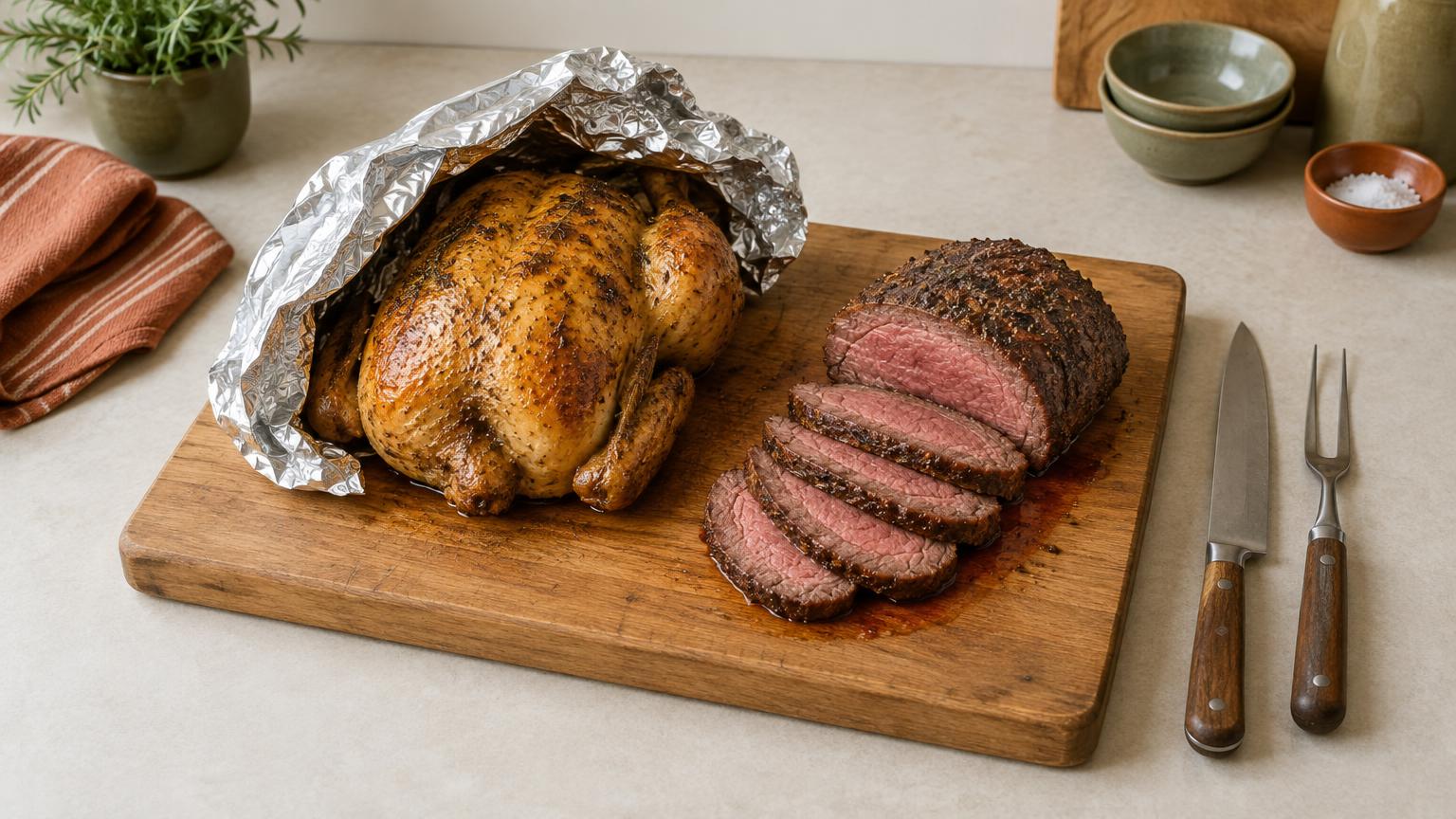
Rest a roast, a bird or a thick steak on a board before you cut it: about 5 minutes for a steak or chop, 10 to 15 for a whole chicken, and 20 to 30 for a turkey or a big beef roast. Two things happen in that time. The heat in the outer layers keeps moving into the centre, so the inside climbs a few more degrees (carryover cooking). And as the meat cools slightly, its juices thicken and the fibres loosen their grip, so far less runs out when you slice.
Skip the rest and you lose both. The centre ends up a little less cooked than you planned, and the juice that should be in each slice pools on the board instead.
What happens inside the meat as it rests
Meat cooks from the outside in. When a roast comes out of a hot oven, the surface is far hotter than the middle, and that heat does not vanish when you close the oven door. It keeps flowing inward, from the hot outside toward the cooler centre, until the temperature evens out.
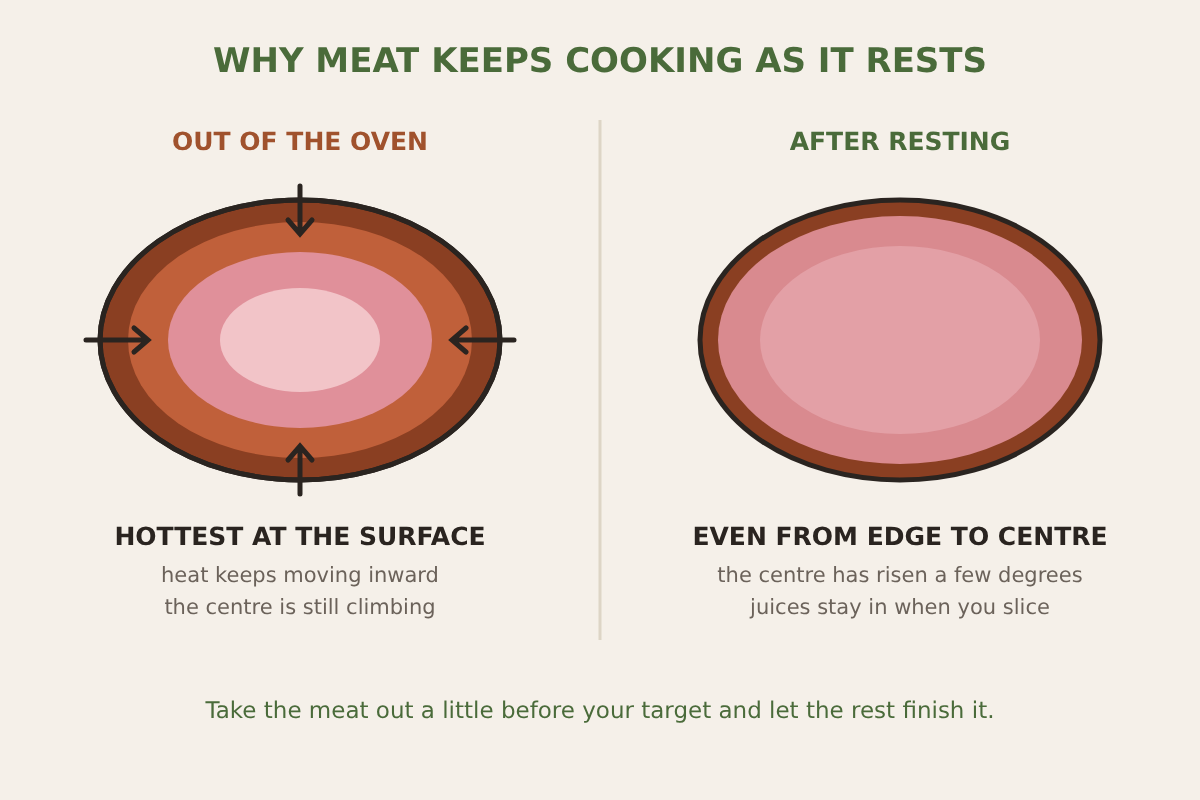
How far the centre climbs depends on two things: how big the piece is and how hot it was cooked. A thin steak from a skillet might rise only a couple of degrees. A large roast from a hot oven holds much more heat in its outer layers and can rise 5 to 10°F (3 to 6°C), sometimes more. A roast cooked low and slow has a smaller gap between surface and centre, so it climbs less.
The juice part is simpler. Hot juices are thin and run freely. Give them a few minutes to cool and settle and they thicken slightly, and more of them stay in the meat when the knife goes through. You will still see some juice on the board after a good rest; you will just see a lot less of it.
How long to rest meat
There is no single right number, but these times work as a guide. Bigger and thicker needs longer.
| What you cooked | Rest for |
|---|---|
| Burgers, fish fillets, thin cutlets | 0 to 3 minutes |
| Steaks and chops about 1 inch (2.5 cm) thick | about 5 minutes |
| Thick steaks, pork tenderloin, chicken breasts | 5 to 10 minutes |
| A whole chicken, a 2 to 4 lb (0.9 to 1.8 kg) roast | 10 to 20 minutes |
| A turkey, a prime rib, a leg of lamb | 20 to 30 minutes |
A large roast stays hot far longer than people expect. A turkey or a standing rib roast under a loose foil tent is still warm enough to serve after 30 minutes, which is why our turkey roasting guide builds the rest into the plan: it is the window for making gravy and getting the sides hot.
When to take the meat out of the oven
Because the centre keeps climbing, take meat out a little before it reaches the doneness you like. For a roast or a thick steak, about 5°F (3°C) early is a sensible margin. For a small, thin cut, take it out at your target, since it will barely rise.
Safety comes first, and the USDA's safe minimum internal temperatures are:
- Whole cuts of beef, pork, veal and lamb (steaks, chops, roasts): 145°F (63°C), then a rest of at least 3 minutes
- Ground meat (burgers, meatloaf): 160°F (71°C)
- All poultry, whole or in pieces, including ground: 165°F (74°C)
- Fish and shellfish: 145°F (63°C)
That 3-minute rest is part of the USDA's own guidance for whole cuts: the meat stays hot enough during it to keep killing bacteria. For poultry and ground meat, take the temperature before the rest and make sure it has already reached the safe minimum; do not count on carryover to get it there. A good instant-read thermometer makes all of this simple, and where you put the probe matters as much as the number.
How to rest meat so the crust stays crisp
- Move it off the hot pan. A roasting pan or skillet keeps cooking the bottom. Lift the meat onto a board, a platter or, best, a wire rack set over a plate so air reaches the underside.
- Tent it loosely with foil, or not at all. A loose sheet of foil over a big roast slows the cooling. Do not wrap it tightly: trapped steam softens the skin or crust you worked to get. For a steak or chops, leave them uncovered; five minutes is too short for them to cool much.
- Keep it somewhere warm, not hot. Next to the stove is fine. Do not put it back in a warm oven, or carryover becomes overcooking.
- Use the time. Make a quick pan sauce in the skillet, whisk the drippings into your gravy, or warm the plates.
- Pour any juice on the board over the slices. It is full of flavour, and after a rest there will not be much of it.
Common mistakes
- Resting it in the pan. The hot metal keeps cooking the underside, and the bottom ends up grey and overdone.
- Wrapping it tightly in foil. The skin on a chicken or the seared crust on a steak goes soft in the steam. Tent loosely, or leave it uncovered.
- Taking it out at the final temperature. On a big roast this is the most common way to overshoot. Pull it a few degrees early and let the rest finish it.
- Resting it so long it goes cold. Small cuts lose their heat quickly. Five minutes is plenty for a steak, and a chicken breast is lukewarm after 20.
- Leaving it out for hours. Cooked meat should go into the fridge within 2 hours of coming off the heat. Carve what you need and refrigerate the rest in shallow containers.
Does resting really matter for a steak?
Less than for a roast, but yes. A thin steak barely carries over, so the main gain is less juice on the plate. For a thick steak both effects show: cut after 5 minutes it holds its juice in the slices, while the same steak cut the moment it leaves the pan sends much more of it onto the board.
If you are short on time, rest for a few minutes rather than none. Most of the benefit comes early.
