
How to Whip Cream: Soft, Medium and Stiff Peaks, and How to Fix It
Cold cream, a cold bowl and an eye on the peak. How to whip cream by hand or mixer, how to tell soft, medium and stiff peaks apart, and how to rescue cream that went too far.
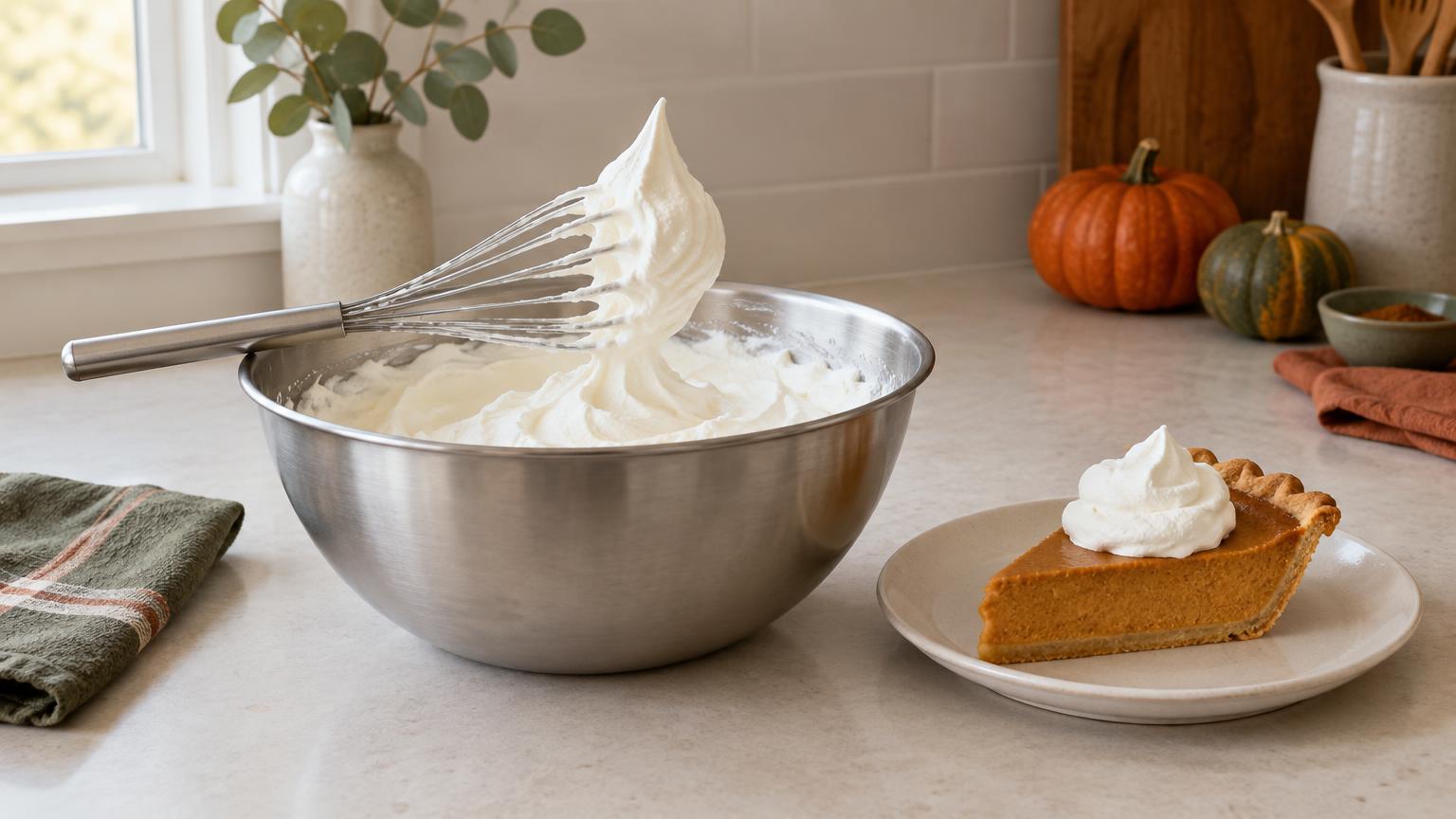
To whip cream by hand or with a mixer, start with cold heavy cream in a cold bowl, whisk until it thickens, then lift the whisk and look at the peak. If the tip flops over, it is soft; if it curls at the top, it is medium; if it stands straight up, it is stiff, and you should stop. One cup (240 ml) of heavy cream gives about 2 cups of whipped cream, enough to top 8 slices of pie.
The whole job takes a few minutes. Most of the skill is in the last 30 seconds, because cream goes from perfect to grainy very quickly.
What happens when you whip cream
Cream is tiny droplets of milk fat floating in liquid. When you whisk it, you beat in air, and the fat droplets get knocked about and partly broken open. The broken fat sticks together around the air bubbles and forms a network that holds them in place. That network is what turns a pourable liquid into a soft, spoonable foam.
Two things follow from that.
The fat has to be cold. Cold milk fat is partly solid, so it can hold a shape around the bubbles. Warm cream has softer fat, whips slowly and collapses quickly, which is why a cold bowl makes such a difference on a warm day.
There also has to be enough fat. In the US, cream sold as heavy cream or heavy whipping cream has at least 36% milk fat, and light whipping cream has 30 to 36%. Both whip, but heavy cream whips faster, holds stiffer peaks and lasts longer. Half-and-half and light cream do not have enough fat to whip at all.
How to whip cream
Makes about 2 cups (480 ml), enough for 8 servings of pie. Contains: dairy. A dairy-free swap is below.
- 1 cup (240 ml) cold heavy cream
- 1 to 2 tablespoons (8 to 15 g) powdered sugar, or 1 tablespoon (12 g) granulated sugar
- ½ teaspoon (2.5 ml) vanilla extract, optional
- Chill the bowl and whisk. Put a metal or glass bowl and the whisk or beaters in the freezer for 10 to 15 minutes. Keep the cream in the fridge until the moment you use it.
- Start slowly. Pour the cream into the cold bowl and whisk on medium speed, or briskly by hand, until it foams and starts to thicken, about a minute with a mixer. Starting slow keeps it from splashing out of the bowl.
- Add the sugar and vanilla once it has started to thicken. Added now, it dissolves while you finish, and it does not get in the way of the first thickening.
- Turn the speed up to medium-high and watch closely. The whisk will begin to leave trails in the cream that hold for a moment before sinking back.
- Check the peak every 15 seconds. Stop the mixer, lift the whisk or a beater straight up, turn it upside down and look at the cream on its tip.
- Finish by hand. As soon as you reach soft peaks, switch to a hand whisk for the last few strokes. It is much easier to stop at exactly the right moment.
How to tell soft, medium and stiff peaks
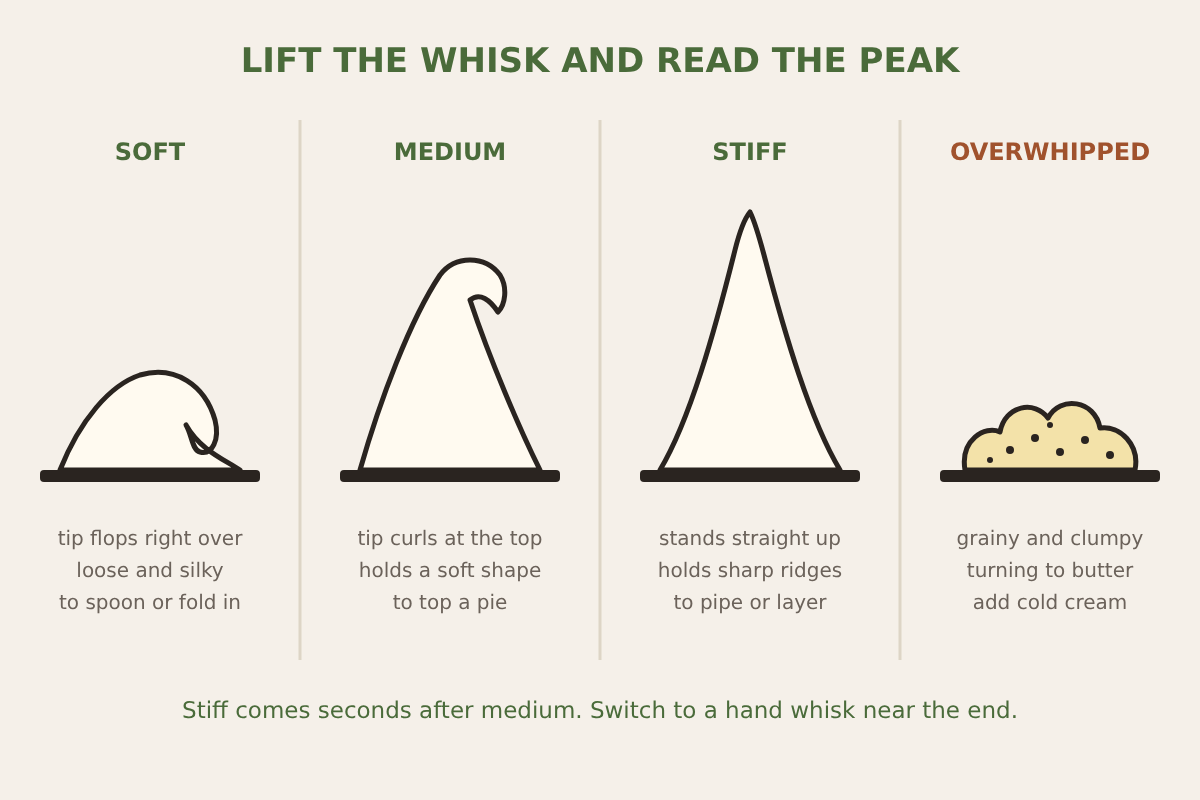
- Soft peaks: the cream mounds on the whisk, but the tip slumps right over and melts back. It is silky and loose. Use it for folding into a mousse or a fruit fool, or spooned over berries.
- Medium peaks: the peak holds, but its tip curls over like a wave. It is smooth and holds a shape on a plate. This is the one for topping pumpkin pie, hot chocolate or a slice of cake.
- Stiff peaks: the peak stands straight up and the cream holds sharp ridges. Use it for piping, layering a trifle or filling a cake. Stop here.
Each stage arrives faster than the one before. With a stand mixer on high, stiff can turn into overwhipped in well under a minute.
Fixing overwhipped cream
If you go too far, the cream loses its shine and turns dull, then grainy and lumpy, with a yellowish tint. That is the fat clumping into butter.
Caught early, it is easy to save. Pour in 2 to 3 tablespoons (30 to 45 ml) of cold, unwhipped cream and fold it in gently with a spatula, not the whisk, until it smooths out. Add a little more if needed.
If it has gone fully to clumps sitting in a thin liquid, you have made butter and buttermilk. Keep beating until the clumps come together, pour off the liquid, and press the butter under cold water. Then start a new batch of cream.
Common mistakes
- Using warm cream or a warm bowl. It takes longer, never gets as stiff and weeps sooner. Chill everything.
- Using a plastic bowl. Plastic can hold a film of grease from earlier use, and it does not stay cold. Metal or glass works better.
- Walking away from a stand mixer. This is how most cream gets overwhipped.
- Whipping it hours before serving with nothing to hold it. Plain whipped cream slowly weeps liquid as it sits.
Making it ahead and keeping it stable
Plain whipped cream holds its shape in the fridge, covered, for a few hours. If a little liquid has collected at the bottom of the bowl by the time you serve, whisk it by hand for a few seconds to bring it back.
To make it hold longer, for the day or for piping that has to stand up:
- Use powdered sugar instead of granulated. It contains a little cornstarch, which helps the cream keep its shape.
- Whip in 2 tablespoons (about 30 g) of mascarpone or softened cream cheese per cup of cream once it starts to thicken. It makes a sturdier, slightly richer cream.
If you are planning a holiday meal, whip it while the pie is cooling or the main course is being cleared, a slot our Thanksgiving cooking timeline leaves free. Whipped cream is perishable: keep it in the fridge, and do not leave it out at room temperature for more than 2 hours.
Dairy-free whipped topping
Chill a can of full-fat coconut milk overnight without shaking it. Open it, scoop out the thick, solid cream from the top and leave the liquid behind. Whip the solid cream with the powdered sugar and vanilla exactly as above. It whips well and tastes of coconut. Check the label for anyone avoiding coconut.
Hand whisk or mixer
A balloon whisk, a hand mixer and a stand mixer with the whisk attachment all work. A stand mixer is the least effort and the easiest to overdo. A hand mixer is the usual middle ground. By hand it takes a few minutes of brisk whisking and a tired arm, but you feel the cream stiffen under the whisk and can stop at exactly the right moment, which is why it is worth finishing by hand even when a machine did most of the work.
Whipped cream is a foam held together by fat. A vinaigrette that does not separate works on a related idea, with oil held as tiny droplets in vinegar instead of fat wrapped around air, and both stay together for the same reason: the right ingredients in the right state, beaten long enough and no longer.
