
Baking Soda vs Baking Powder: Which to Use and How to Swap
Baking soda needs an acid in the recipe; baking powder brings its own. How to tell which a recipe needs, why many use both, substitutions that work, and a 30-second freshness test.
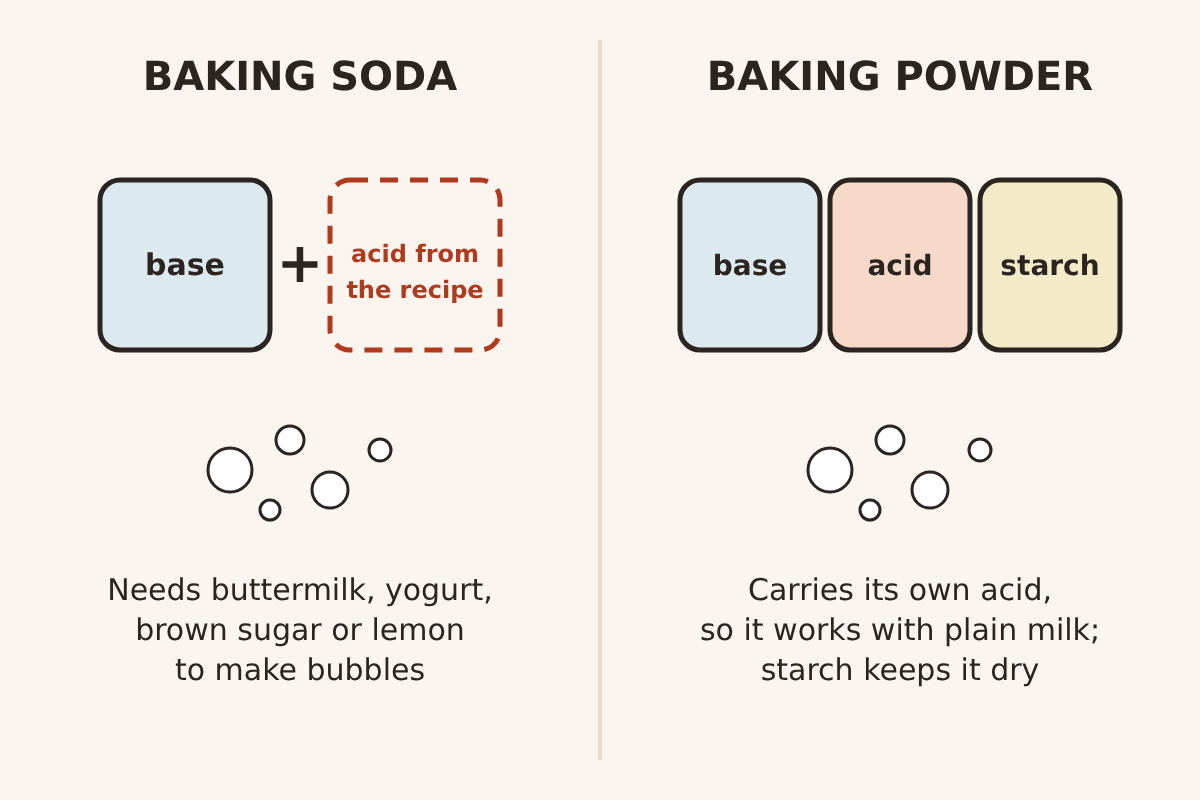
Baking soda and baking powder both make baked goods rise by releasing carbon dioxide, but they are not interchangeable spoon for spoon. Baking soda is a pure base and only works when the recipe has an acid in it, such as buttermilk, yogurt or brown sugar. Baking powder is baking soda with the acid already mixed in, so it works in a batter made with plain milk. Soda is also much stronger: a quarter teaspoon of it does roughly the work of a full teaspoon of baking powder.
What each one is
Baking soda is sodium bicarbonate. On its own it does almost nothing in a batter. When it meets an acid and some moisture, it reacts straight away and gives off bubbles of carbon dioxide, which the batter traps and the oven sets.
Baking powder is baking soda mixed with one or more dry acids and a little starch. The starch soaks up moisture from the air so the soda and acid do not react in the can. Most baking powder sold in US supermarkets is double-acting: it releases some gas as soon as it gets wet and the rest once it heats up in the oven. That second burst is why a batter made with it can sit for a few minutes without going flat.
How to tell which one a recipe needs
Look for an acidic ingredient. Common ones in baking:
- buttermilk, yogurt, sour cream and kefir
- brown sugar, molasses and honey
- natural (non-alkalized) cocoa powder
- lemon juice, vinegar and cream of tartar
- ripe bananas, applesauce and pumpkin, which are mildly acidic
If a recipe has one of these, it will usually call for baking soda, often alongside some baking powder. A recipe with only plain milk, white sugar and Dutch-process cocoa has nothing for soda to react with, so it relies on baking powder.
Why many recipes use both
Fluffy buttermilk pancakes are a good example. The baking soda reacts with the acid in the buttermilk. That neutralises some of the tang and gives the first lift as the batter rests. The baking powder adds more rise on the griddle, since there is not enough soda to lift the batter by itself without leaving a soapy taste.
Soda also changes colour and texture. It makes a batter less acidic, and a less acidic dough browns faster and spreads more in the oven. That is part of why chewy chocolate chip cookies made with soda and brown sugar come out golden and spread into wide, crinkled rounds, and why one-bowl banana bread gets its deep brown crust.
Substitutions that work
Out of baking powder? For each 1 teaspoon (4 g) of baking powder, use ¼ teaspoon (1.5 g) of baking soda plus ½ teaspoon (1.5 g) of cream of tartar. Mix them into the dry ingredients and bake soon after the batter is mixed, because this homemade version is single-acting: all of its gas is released when it gets wet.
If you have no cream of tartar, use ¼ teaspoon (1.5 g) of baking soda and replace ½ cup (120 ml) of the recipe's milk with buttermilk or plain yogurt thinned with a little milk. If you have neither, the buttermilk substitutes guide shows how to sour milk with lemon juice or vinegar.
Out of baking soda? Use about three times as much baking powder: 1 tablespoon (12 g) of baking powder for each 1 teaspoon (5 g) of baking soda. This works best when a recipe calls for only a little soda. The result will be paler, a little less tender and slightly tangier, since nothing neutralises the acid in the recipe. In a recipe with a lot of soda, the extra baking powder can leave a bitter taste, so it is better to wait until you can buy soda.
Never swap them one for one. A teaspoon of soda in place of baking powder gives a dense bake with a soapy, metallic taste, and a teaspoon of powder in place of soda gives one that barely rises.
Measure them carefully
These are the strongest ingredients in a recipe by weight, so a small mistake shows. Level each spoonful with a knife instead of heaping it, and whisk them into the flour before they meet anything wet, so no pocket of soda ends up in one bite. If you weigh, a level teaspoon of baking soda is about 5 grams and a level teaspoon of baking powder about 4 grams.
Check that they still work
Both lose strength over time, baking powder especially, because moisture from the air starts its reaction in the can. A flat cake or dense muffins from a recipe that usually works is often an old can of baking powder.

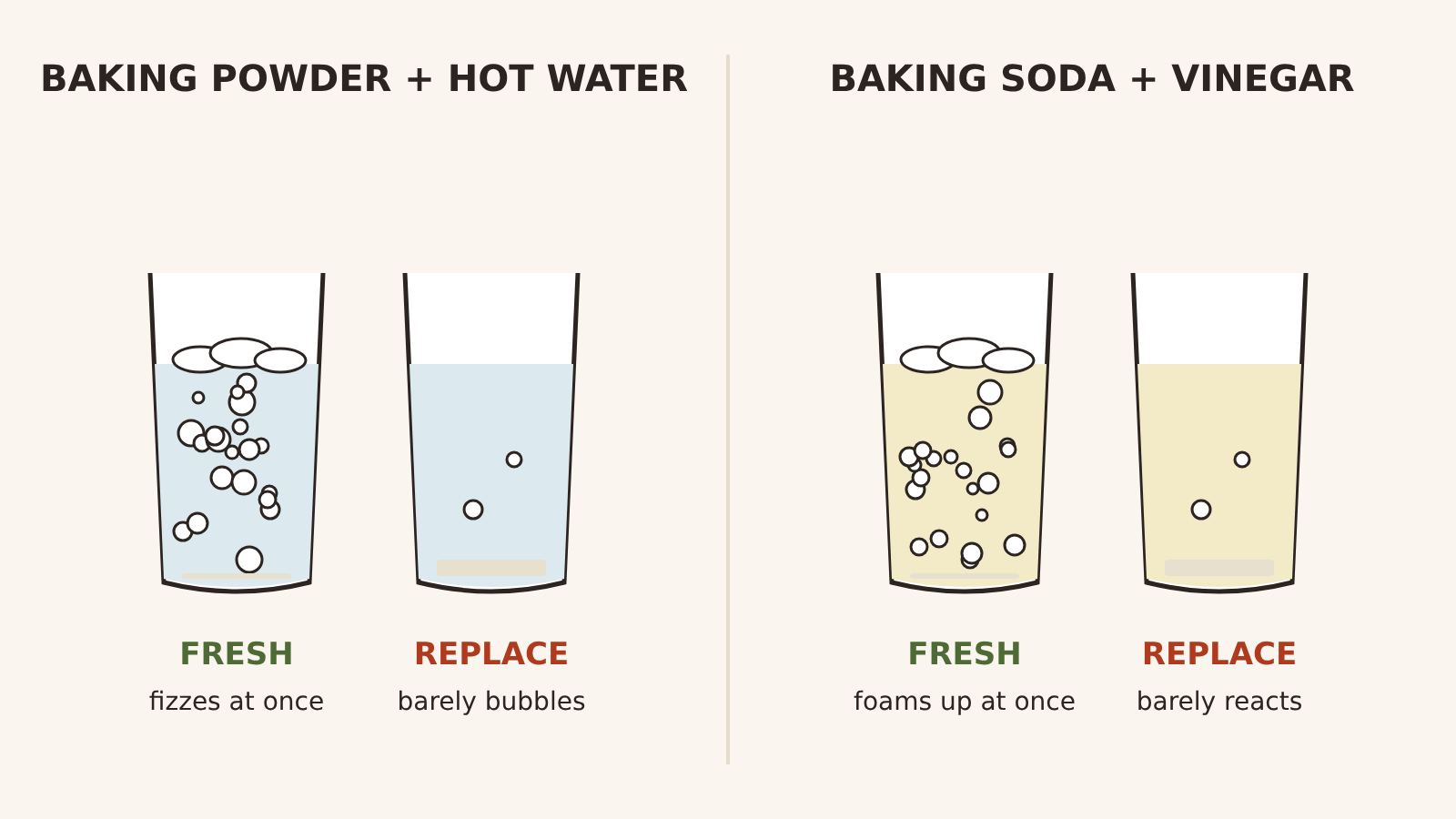
- Baking powder: stir ½ teaspoon into ¼ cup (60 ml) of hot water. It should fizz vigorously right away.
- Baking soda: drop ¼ teaspoon into 2 teaspoons (10 ml) of vinegar or lemon juice. It should foam up at once.
How to store them
Keep both in their containers with the lids closed tightly, in a cool, dry cupboard away from the stove and the kettle, where steam can get in. Write the date you opened them on the lid, and test them if you have not baked in a while.
Keep a separate box of baking soda for baking. An open box used to absorb smells in the fridge takes on those smells, and you do not want them in a cake.
Allergens
Baking soda is a single ingredient. Most baking powder uses cornstarch to stay dry, but some brands use wheat starch, so check the label if you bake gluten-free. Cream of tartar is a by-product of winemaking and contains no common allergens.
