
Leftover Mashed Potato Cakes That Hold Together and Fry Up Crisp
Turn cold leftover mashed potatoes into crisp, golden potato cakes in about 25 minutes, with the four reasons they fall apart and how to stop each one.
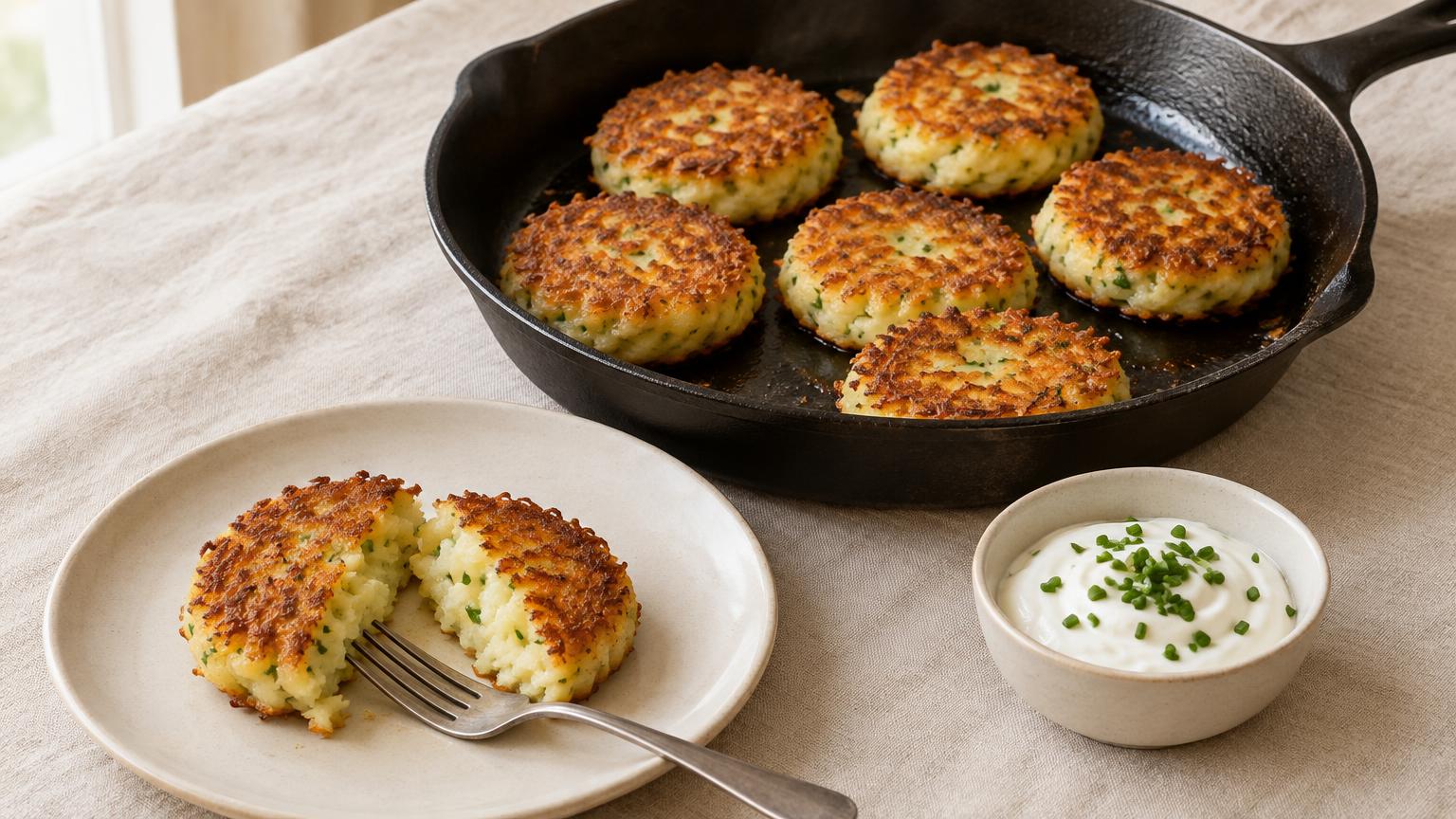
Leftover mashed potatoes turn into crisp, golden potato cakes in about 25 minutes, as long as the mash is cold. Straight from the fridge it is firm enough to shape and hold together in the pan; warm mash slumps, sticks and splits when you flip it. Add one egg and a little flour, shape thick patties, and fry them in a hot skillet without moving them until a crust forms.
Makes: 8 cakes, serves 4 as a side or 2 to 3 as a light meal Prep: 10 minutes | Cook: 15 to 20 minutes (in two batches) Allergens: egg, gluten (flour), dairy (the mash itself, Parmesan, butter). No nut, soy or shellfish ingredients; swaps below.
Ingredients
- 2 cups (about 450 g) cold leftover mashed potatoes
- 1 large egg
- 1/3 cup (40 g) all-purpose flour, plus 1/4 cup (30 g) for coating
- 1/4 cup (25 g) finely grated Parmesan (optional)
- 2 tablespoons (6 g) finely chopped fresh chives or 2 thinly sliced green onions
- 1/4 teaspoon (0.5 g) ground black pepper
- Fine salt, to taste (leftover mash is usually already seasoned)
- 3 to 4 tablespoons (45 to 60 ml) neutral oil, such as vegetable or canola
- 1 tablespoon (14 g) butter (optional, for flavor)
- Sour cream and extra chives, for serving
Any mashed potatoes work, but stiffer ones make the job easier. If yours were made loose with lots of milk and cream, as our make-ahead mashed potatoes are, plan on the extra spoonful of flour in step 2.
Instructions
- Start with cold mash. Use mashed potatoes that have been in the fridge for at least a few hours, ideally overnight. As cooked potato chills, its starch firms up, so the mash holds a shape. If you only have warm mash, spread it on a plate and refrigerate it for an hour first.
- Mix the batter. In a bowl, beat the egg, then add the cold mash, 1/3 cup (40 g) flour, the Parmesan, chives and pepper. Stir with a fork until just combined. Pinch off a little and roll it into a ball: it should hold its shape without sticking badly to your fingers. If it is sticky or soft, add flour a tablespoon (8 g) at a time. Taste the mix and add salt only if it needs it, since cheese and the original seasoning already add plenty.
- Shape thick patties. Divide the mix into 8 portions of about 1/4 cup each. With floured hands, shape each into a patty about 2 1/2 inches (6 cm) across and 1/2 inch (1.3 cm) thick, with straight sides. Press them firm. Thin patties break, and a cake much thicker than this browns outside before the center heats through.
- Coat in flour. Spread the remaining 1/4 cup (30 g) flour on a plate and press each patty lightly into it on both sides, then tap off the excess. The thin dry layer browns into the crust and stops the cakes sticking.
- Heat the pan properly. Heat a large skillet, cast iron or nonstick, over medium heat for 2 to 3 minutes. Add 2 tablespoons (30 ml) of oil and half the butter. The pan is ready when the butter foams and the oil shimmers; our guide to telling when a pan is hot enough shows what to look for. A cold pan lets the cakes soak up oil and stick.
- Fry without moving them. Add 4 cakes, leaving space between them. Cook 4 to 5 minutes, without nudging or pressing, until the underside is deep golden. The crust releases from the pan once it has formed; if a cake resists your spatula, give it another minute.
- Flip once and finish. Turn each cake carefully with a thin spatula and cook the second side 3 to 4 minutes, until golden. The center should be steaming hot; an instant-read thermometer pushed in from the side should read 165°F (74°C), which is the USDA's temperature for reheated leftovers and above the 160°F (71°C) it gives for dishes made with egg.
- Keep warm and repeat. Move the cakes to a rack set over a baking sheet in a 200°F (95°C) oven while you fry the second batch with the remaining oil and butter. A rack keeps the bottoms crisp; a paper towel under them traps steam.
Serve hot with sour cream and chives, or under a fried egg.
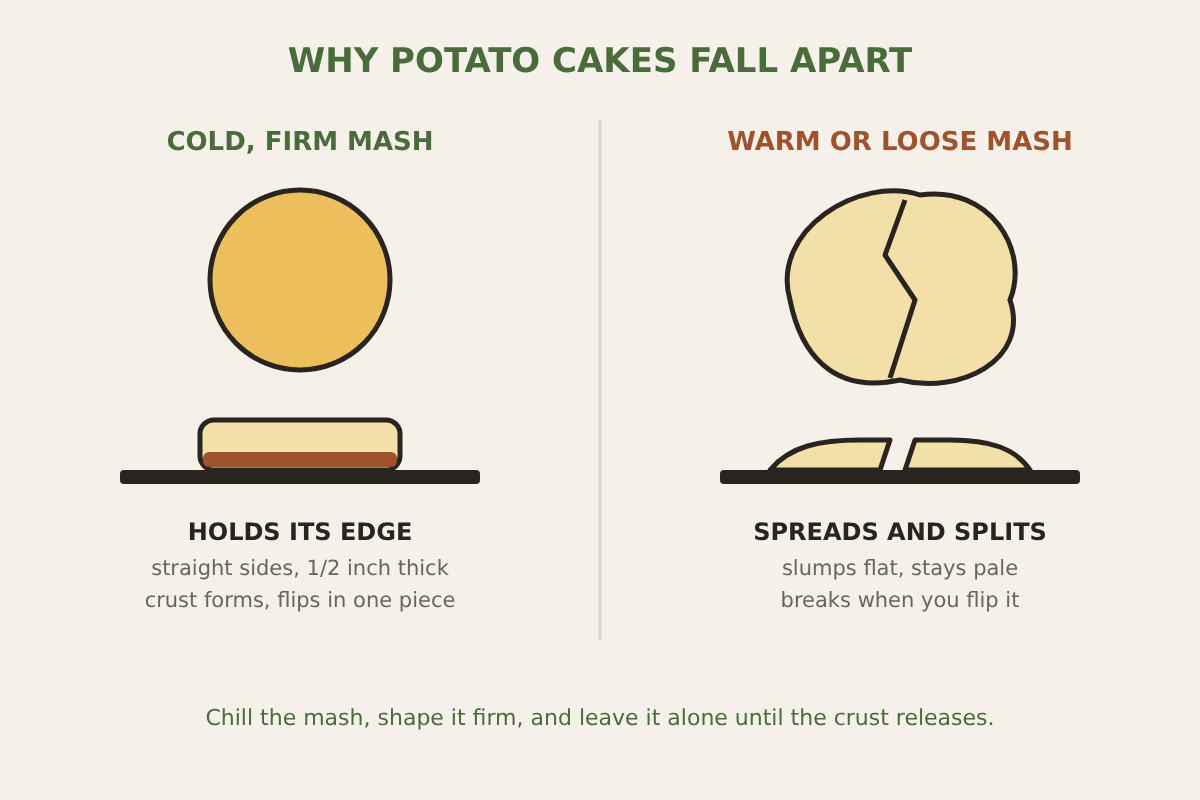
If your cakes fall apart
Almost every broken potato cake comes down to one of four things:
- The mash was warm. Chill it first; this makes the biggest difference.
- The mix was too wet. Very creamy mash needs more flour to bind. Add it a tablespoon at a time and test a small ball again.
- You flipped too early. Before the crust sets, the cake is still soft mash. Wait for it to release on its own.
- The cakes were thin or uneven. Half an inch with straight sides gives enough body to survive the flip.
These cakes are softer and creamier inside than crispy potato latkes, which start from raw grated potato and fry up lacy and crunchy all the way through. If you are clearing out the fridge after a holiday meal, they make a good side for leftover turkey.
Swaps and variations
- Gluten-free: use a 1:1 gluten-free flour blend or cornstarch, in the same amounts, for both the mix and the coating. Check that your mash had no gluten-containing ingredients added.
- Egg-free: leave out the egg and add 1 to 2 extra tablespoons (8 to 16 g) of flour. The cakes are more fragile, so chill the shaped patties for 15 minutes before frying and flip them very gently.
- Dairy-free: this works only if the mash itself was made without dairy. Skip the Parmesan and fry in oil alone.
- Cheesy: replace the Parmesan with 1/2 cup (55 g) shredded sharp cheddar.
- Crunchier crust: coat the patties in 1/2 cup (30 g) panko breadcrumbs instead of flour. Panko contains wheat.
- Leftover stuffing or vegetables: fold in up to 1/2 cup (about 60 g) of finely chopped cooked vegetables or ham. Keep the pieces small so the cakes still hold together.
Storage and reheating
- Mash: use leftover mash within 3 to 4 days of when it was first cooked, the USDA guideline for cooked leftovers kept in the fridge. Make the cakes inside that window.
- Fridge: cool cooked cakes and refrigerate them within 2 hours in a covered container. Eat within 3 to 4 days of when the mash was first made, not when you fried the cakes.
- Freezer: freeze cooked, cooled cakes in a single layer on a tray, then move them to a freezer bag. Use within about 1 month for best texture.
- Reheating: bake on a rack over a baking sheet at 375°F (190°C) for 10 to 15 minutes from the fridge, or 20 to 25 minutes from frozen, until hot in the center (165°F / 74°C). An oven or air fryer brings back the crust; a microwave leaves them soft.
- Make ahead: you can shape and coat the patties, cover them and refrigerate them for up to a day before frying, as long as the mash is still within its 3 to 4 days.
Food safety guidance: USDA Food Safety and Inspection Service, Leftovers and Food Safety and Safe Minimum Internal Temperature Chart.
