
Black-Eyed Peas and Collard Greens for New Year's Day
One pot, no soaking, and a smoky broth you will want bread for. Dried black-eyed peas simmered with a ham hock, collard greens cooked until silky, and the story behind eating them on January 1.
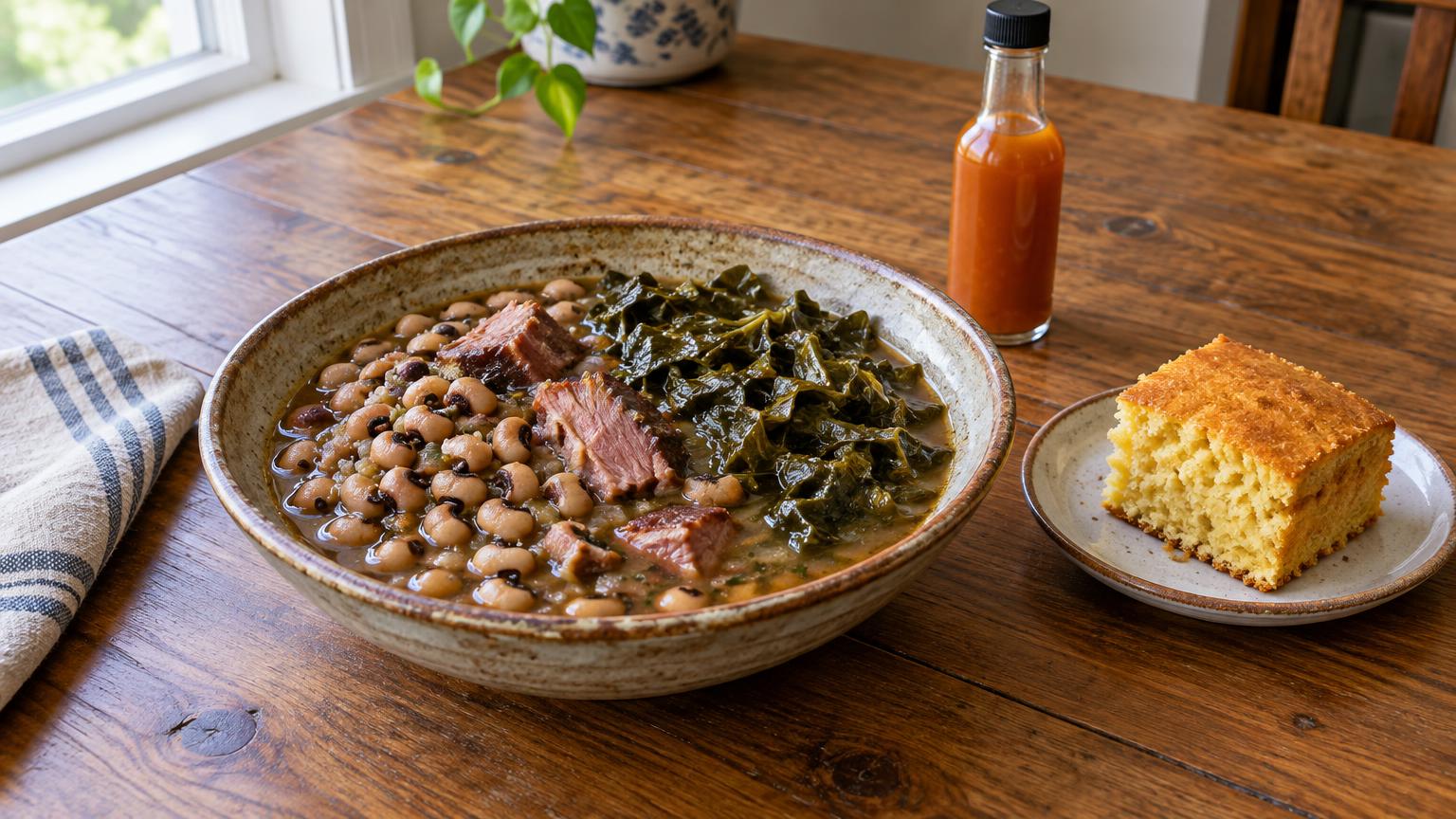
Simmer dried black-eyed peas with a smoked ham hock for about 45 minutes, add collard greens, and cook 25 to 30 minutes more, until the peas are creamy and the greens are silky. A splash of vinegar at the end brightens the pot. It needs no soaking, and it is better made the day before, which suits a holiday when nobody wants to start cooking early.
Serves: 6 to 8 Prep time: 15 minutes Cook time: about 1 hour 30 minutes Contains: no gluten, dairy, nuts, eggs, shellfish or soy in the pot itself. Check the labels on stock and on the ham hock. Cornbread on the side usually contains gluten, dairy and eggs.
Why peas and greens on New Year's Day
In the American South, black-eyed peas and greens are the classic first meal of the year. The usual telling goes like this: the peas stand for coins, the greens for paper money, and the cornbread on the side for gold. Rice and pork often join them, and peas cooked with rice and pork are known as Hoppin' John.
The origins are less tidy than the symbolism. Peas and rice dishes trace back to the foodways of enslaved West Africans in the Lowcountry of South Carolina and Georgia, while other stories connect lucky black-eyed peas with Rosh Hashanah traditions. No single account is proven, and the luck itself is a pleasant belief, so feel free to serve it for the flavor alone.
Ingredients
- 2 tablespoons (30 ml) neutral oil
- 1 large yellow onion, about 10 ounces (285 g), diced
- 2 celery stalks, about 3½ ounces (100 g), diced
- 4 garlic cloves, about ½ ounce (15 g), chopped
- 1 pound (450 g) dried black-eyed peas, rinsed and picked over
- 1 smoked ham hock, about 1 pound (450 g)
- 8 cups (1.9 liters) water or low-sodium chicken stock
- 2 bay leaves
- ½ teaspoon crushed red pepper flakes
- 1 large bunch collard greens, about 1 pound (450 g)
- 1 to 2 teaspoons (6 to 12 g) fine salt, to taste
- 1 to 2 tablespoons (15 to 30 ml) apple cider vinegar
- Hot sauce, cooked rice or cornbread, to serve
Steps
- Heat the oil in a large, heavy pot over medium heat. Add the onion and celery with a pinch of salt and cook for 6 to 8 minutes, until soft. If you need a refresher, here is how to dice an onion quickly and evenly. Add the garlic and stir for 1 minute.
- Add the peas, ham hock, water or stock, bay leaves and red pepper flakes. Bring to a boil, then lower the heat to a gentle simmer.
- Partly cover and cook for 45 minutes, stirring now and then. A hard boil splits the skins and turns the peas to mush, so keep the bubbles lazy.
- While that simmers, wash the collards well in several changes of water, because grit hides in the folds. Cut out the thick stems and slice the leaves into ribbons about 1 inch (2.5 cm) wide.
- Lift the hock out to a plate. Stir the greens into the pot, a handful at a time, letting each wilt before you add the next.
- When the hock is cool enough to handle, pull the meat off and chop it. Throw away the skin, bone and fat. Return the meat to the pot.
- Simmer, partly covered, for another 25 to 30 minutes, until the peas are creamy and the greens are silky. Add a splash of water if it looks dry. Older dried peas can take longer, so taste a few before you decide.
- Take out the bay leaves. Salt to taste now rather than early on, because the hock adds salt as it cooks. Stir in 1 tablespoon (15 ml) of vinegar, taste and add more if the pot tastes flat.
- Serve in bowls over rice, or with cornbread and hot sauce on the table.
Why it works
Smoked hock is mostly skin, bone and connective tissue, and long simmering melts that into the broth, giving it body and a smoky depth that water alone cannot get. This is a similar slow build to a good chili, though the seasoning here comes almost entirely from the pork. Collards are tough leaves that stand up to long cooking, so they soften without turning to slime, and the vinegar at the end balances the richness of the pork and the slight bitterness of the greens.
The broth is half the point, so serve something to soak it up.
Black-eyed peas are one of the few dried beans that cook well without soaking, thanks to their small size and thin skin. You can soak them overnight if you like; just start checking them after about 30 minutes in step 3.
Swaps
- Vegetarian or vegan: skip the hock and use vegetable stock, 2 teaspoons (4 g) smoked paprika and 1 tablespoon (15 ml) soy sauce. Soy sauce contains soy and usually gluten, so use tamari if you need to avoid wheat.
- Other smoked meat: a smoked turkey leg works in place of the hock, and so does the bone from a glazed ham with whatever meat is left on it. Anything already cooked needs to come back up to 165°F (74°C) in the pot, which a long simmer does easily.
- Other greens: kale cooks in about 15 minutes, and turnip or mustard greens in about 20. Mustard greens taste sharper, so add a pinch of sugar if you like.
- Canned peas: use 3 cans (15 ounces / 425 g each), drained. Simmer the hock in the liquid for 1 hour first, and add the peas with the greens.
Storage and reheating
Cool the pot quickly and refrigerate within 2 hours in shallow containers. It keeps for 3 to 4 days in the fridge and freezes well for up to 3 months, although the greens soften a little more.
Reheat over medium heat until it reaches 165°F (74°C), adding a splash of water, because the peas keep absorbing liquid overnight. Add a fresh splash of vinegar before serving, as it fades as the pot sits.
